5 Best Email Template Builder With Reusable Blocks
Email template builder with reusable blocks helps teams save and reuse headers, CTAs, and modules. Compare top tools to find the best fit for your workflow.

Md. Yaikub Hossain Razon
An email template builder with reusable blocks lets you save headers, footers, CTAs, product sections, and other email modules for future campaigns. The best builders make these blocks easy to organize, customize, reuse, and keep consistent across your email workflow.
Reusable modules are especially useful for teams that send newsletters, promotions, product announcements, onboarding emails, and other recurring campaigns.
Instead of rebuilding common sections for every email, marketers can create an approved block once and insert it whenever needed.
This guide compares five of the best email template builders with reusable modules in 2026. We reviewed their reusable-content workflows, responsive controls, brand features, collaboration options, and export flexibility.
For teams that want reusable modules alongside visual HTML editing and flexible export, MailEditor is our top overall pick.
What Are Reusable Email Blocks?
Reusable email blocks are pre-designed sections that you save once and insert into future email campaigns.
A block may contain one element or several elements working together.
For example, a reusable product block could include:
-
Product image
-
Product title
-
Description
-
Price
-
CTA button
-
Spacing and styling
Other common reusable email modules include:
-
Headers
-
Navigation
-
Hero sections
-
Newsletter cards
-
Promotional banners
-
Feature sections
-
Testimonials
-
Social media sections
-
CTAs
-
Legal notices
-
Footers
A reusable block is different from a complete email template.
A template contains the entire email layout. A block represents one reusable section within that layout.
Teams that want to create complete repeatable campaign structures can also follow MailEditor’s guide to create reusable email templates.
Why Reusable Email Modules Matter
Reusable modules reduce repeated design work while helping teams keep email layouts consistent.
Suppose you send a newsletter every week.
The content changes, but many structural elements remain the same:
-
Logo
-
Header
-
Article layout
-
CTA style
-
Social links
-
Footer
Rebuilding these sections every week adds unnecessary work.
With reusable blocks, the workflow becomes:
Choose modules → Add content → Customize → Preview → Test → Export
This is also useful for maintaining consistent branding.
Approved modules can preserve:
-
Typography
-
Brand colors
-
Button styles
-
Image proportions
-
Padding
-
Section spacing
-
CTA presentation
Reusable components therefore work best as part of an email design system.
Litmus describes an email design system as a collection of reusable components and standards that help teams create consistent emails more efficiently.
Our Reuse Maturity Framework
Not every feature called a reusable block works in the same way.
We use this five-level framework when comparing email builders.
|
Level |
Reuse Type |
What It Does |
|
1 |
Duplicated block |
Copies a section within one email |
|
2 |
Saved block |
Stores a section for later campaigns |
|
3 |
Shared library |
Makes approved blocks available to a team |
|
4 |
Synced block |
Updates connected instances from a master block |
|
5 |
Portable system |
Lets reusable designs move into different sending platforms |
A freelancer may only need saved blocks.
A growing marketing team may need shared libraries.
Large organizations may prefer synchronized modules for centrally managed content.
Agencies may prioritize portability because they often work across several ESPs.
Understanding these levels makes comparing builders much easier.
What Makes a Good Reusable Block Builder?
A strong email template builder with reusable blocks should do more than save sections.
We evaluated the tools using seven core criteria.
1. Reusable Block Creation
You should be able to save useful sections without rebuilding them.
2. Module Organization
Libraries, categories, folders, or search help teams manage larger block collections.
3. Brand Controls
Reusable sections should follow approved colors, fonts, buttons, and spacing.
4. Responsive Design
Modules should work across desktop and mobile layouts.
5. Shared Content
Teams may need shared or synchronized reusable components.
6. HTML and ESP Export
Finished emails should fit into your sending workflow.
7. Editing Experience
Marketers should be able to update recurring modules without unnecessary technical work.
Best Email Template Builders With Reusable Blocks
Quick Comparison
|
Builder |
Best For |
Reusable Content |
Brand Controls |
Export Flexibility |
|
MailEditor |
Best overall |
Saved and pre-built modules |
Strong |
Strong |
|
Stripo |
Synced modules |
Saved and synchronized modules |
Strong |
Strong |
|
RGE Studio |
Team collaboration |
Saved and synced rows |
Strong |
Strong |
|
Chamaileon |
Design systems |
Project, Master, and Design System Blocks |
Strong |
Strong |
|
Tabular |
Responsive modules |
Teamspace reusable blocks |
Strong |
Strong |
1. MailEditor

Best Overall Email Template Builder With Reusable Blocks
MailEditor is our top overall choice for teams that want to build responsive emails using reusable modules while keeping their email workflow flexible.
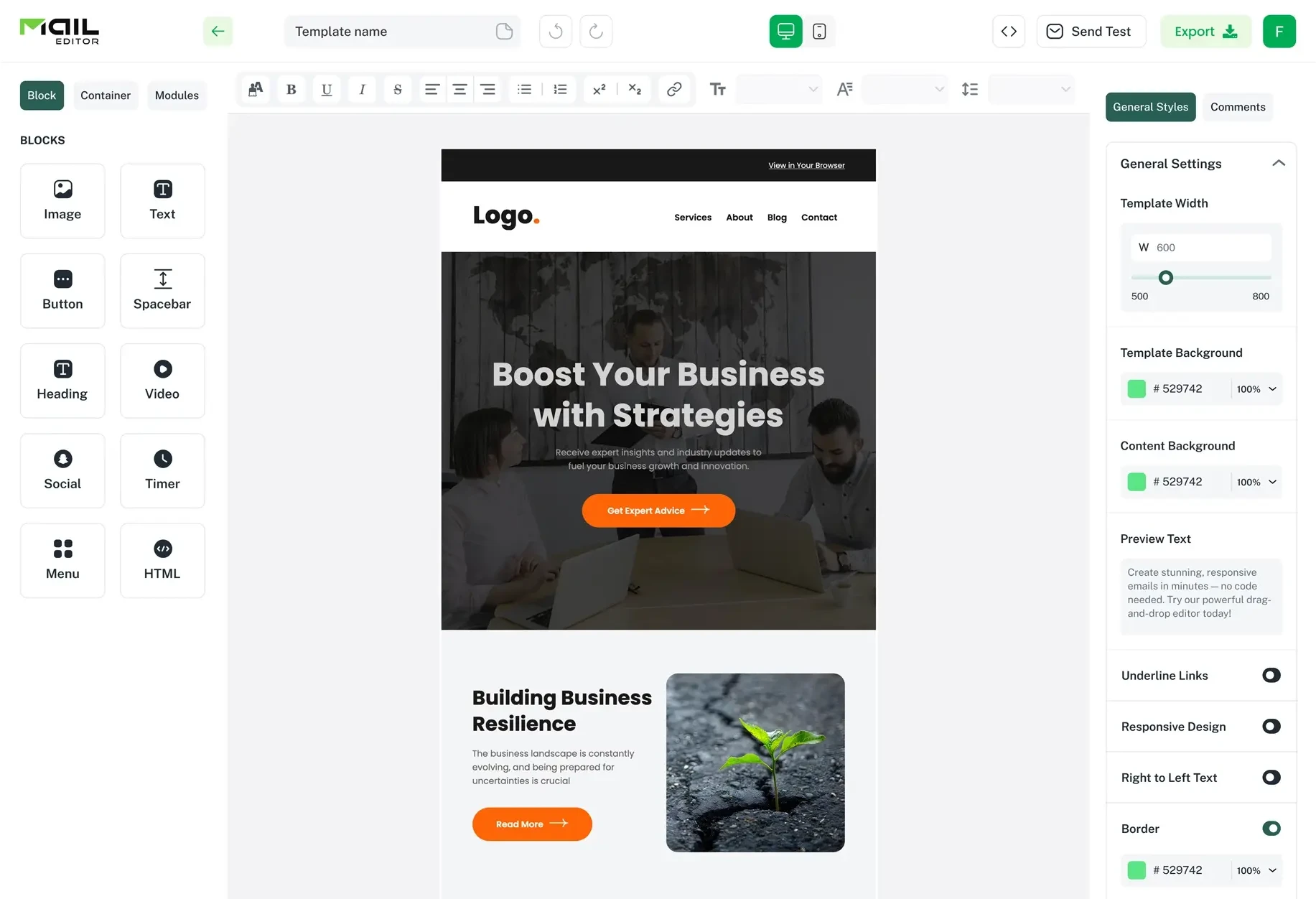
Its dedicated MailEditor Module Builder lets users assemble emails with ready-made sections and save custom blocks for future campaigns.
MailEditor’s current module workflow includes headers, footers, promotional sections, newsletter layouts, pricing sections, and other reusable email components.
Reusable MailEditor Modules
Teams can reuse sections such as:
-
Headers
-
Hero areas
-
Product cards
-
Newsletter sections
-
Promotional banners
-
Pricing sections
-
CTA areas
-
Social sections
-
Footers
This changes email production from repeated design work into modular assembly.
Instead of rebuilding a product section for every promotion, save the layout and reuse it when needed.
MailEditor describes Saved Blocks as custom sections that can be stored and reused across future campaigns.
Pre-Built Email Modules
MailEditor also includes a growing collection of professionally designed modules.
That means you do not need to create every component from scratch.
You can start with a pre-built section, customize it for your brand, and incorporate it into your own reusable workflow.
The broader MailEditor feature set includes pre-built modules, branded modules, visual email editing, mobile-responsive layouts, raw HTML blocks, and other email production tools.
Branded Modules
Reusable sections become more valuable when they follow the same brand system.
MailEditor supports presets and brand controls for elements such as:
-
Fonts
-
Colors
-
Buttons
-
Links
-
Text
-
Modules
That helps marketers avoid styling the same CTA or content block differently in every campaign.
Reuse Existing HTML Emails
MailEditor is also useful when your reusable workflow does not start from scratch.
Teams can work with existing HTML email designs inside a visual editing environment.
This is useful for organizations that already have a collection of campaigns or templates they want to continue using.
Instead of discarding an existing email structure, teams can update it and incorporate useful sections into future workflows.
If your main goal is developing complete repeatable templates, read MailEditor’s detailed guide on how to create reusable email templates.
Flexible ESP Workflow
MailEditor focuses on email creation rather than locking design into one sending platform.
After building your email, you can move the final HTML into the email service provider used by your team.
MailEditor supports workflows involving platforms such as:
-
HubSpot
-
Mailchimp
-
Klaviyo
-
Brevo
-
SendGrid
-
Campaign Monitor
-
ActiveCampaign
-
Other HTML-compatible email platforms
For the complete workflow, see how to export HTML email templates to any ESP.
Start From Ready Templates
You can also begin with an existing email design instead of a blank canvas.
MailEditor provides responsive template collections for newsletters, corporate emails, publishing, ecommerce, promotions, business communication, and other campaign types.
For recurring newsletter campaigns, explore MailEditor’s responsive newsletter email templates.
These provide a starting structure that can then be customized with reusable modules.
Why We Picked MailEditor
MailEditor combines several features that work well together:
-
Pre-built email modules
-
Saved reusable blocks
-
Branded modules
-
Visual email editing
-
Responsive layouts
-
Existing HTML workflows
-
HTML export
-
ESP flexibility
That combination makes it especially suitable for teams that want reusable content without tying their entire email design process to one sending platform.
Best For
MailEditor is best for:
-
Marketing teams
-
Small businesses
-
Agencies
-
Ecommerce brands
-
Newsletter publishers
-
Teams with existing HTML templates
-
Multi-ESP workflows
-
Marketers who want reusable modules without coding
2. Stripo

Best for Synchronized Email Modules
Stripo is a strong option for teams that want reusable sections with synchronized content capabilities.
Its module system allows users to save email structures and use them again across future emails.
Saved modules can include complete combinations of content and layout.
Examples include:
-
Navigation headers
-
Product cards
-
Promotional blocks
-
Event sections
-
CTA rows
-
Social sections
-
Footers
Module Library
Stripo provides a dedicated module library.
Teams can save custom modules and search them when building future emails.
Modules can also be categorized to make larger libraries easier to manage.
That becomes increasingly important as the number of reusable sections grows.
A library with five modules needs little organization.
A library with 50 needs clear naming, categories, and ownership.
Synchronized Modules
Stripo also supports synchronized modules.
A synchronized component can remain connected to its master version.
This is useful for content that should stay consistent across different emails.
Examples include:
-
Company address
-
Legal disclaimer
-
Standard navigation
-
Brand footer
-
Global promotional notice
Instead of locating every design separately, a team can maintain the central module according to the workflow supported by the platform.
Best For
Stripo is best suited to teams that want:
-
Saved modules
-
Synchronized email components
-
Large module libraries
-
Repeated campaign sections
-
Multi-platform email workflows
3. RGE Studio

Best for Collaborative Reusable Rows
RGE Studio provides reusable email content through Saved Rows and Synced Rows.
Its current training materials explain that Saved Rows help users save, reuse, and synchronize content across email and landing-page designs.
Standard Saved Rows
A Saved Row can contain several elements.
For example, a recurring newsletter section might include:
-
Image
-
Category
-
Headline
-
Intro text
-
CTA
Once stored, the row can become a reusable building piece for later emails.
This is useful for newsletters, product campaigns, ecommerce promotions, and recurring announcements.
Synced Rows
RGE Studio also provides Synced Rows.
These are particularly useful when a recurring section should remain centrally controlled.
A common example is a footer containing:
-
Address
-
Navigation
-
Social links
-
Brand information
-
Standard legal content
Instead of recreating that footer, teams can work from the reusable version.
Collaboration
RGE Studio’s reusable-content workflow also fits collaborative email production.
That makes it a useful option when several people work with shared designs.
Designers can create approved components while marketers use those components to assemble campaigns.
Best For
RGE Studio is suitable for:
-
Marketing teams
-
Agencies
-
Shared email production
-
Repeat campaigns
-
Saved rows
-
Synced content
-
Collaborative design workflows
4. Chamaileon

Best for Email Design Systems
Chamaileon is designed around structured email creation and collaborative workflows.
Its reusable block approach fits teams that want to develop a more formal email design system.
The platform organizes reusable content into different levels.
Project Blocks
Project Blocks can be reused inside a defined project.
These work well when one campaign series needs its own set of recurring components.
For example, an event series may repeatedly use the same:
-
Event header
-
Speaker section
-
Schedule module
-
Registration CTA
-
Footer
Master Blocks
Master Blocks support broader reusable-content workflows.
Teams can use them for common branded elements that appear across several campaigns.
Good candidates include:
-
Main headers
-
Navigation
-
CTAs
-
Legal content
-
Footers
Design System Blocks
Design System Blocks help organizations structure reusable sections as part of a wider design system.
This approach becomes useful when multiple marketers or designers create emails for one brand.
Instead of everyone interpreting the visual system independently, approved sections provide consistent starting points.
Best For
Chamaileon is best for teams that prioritize:
-
Email design systems
-
Reusable branded components
-
Structured content libraries
-
Collaborative production
-
Scalable design governance
5. Tabular

Best for Responsive Reusable Blocks
Tabular combines reusable building blocks with detailed responsive-email controls.
Its product documentation specifically highlights the ability to create reusable email blocks for faster email production.
This makes it useful for marketers who want modular content while keeping close control over how emails behave on different screens.
Reusable Team Blocks
Teams can create reusable blocks containing combinations such as:
-
Headers
-
Product rows
-
Article sections
-
Promotion modules
-
CTA areas
-
Footers
These components can then be inserted into future templates.
Shared Styles
Tabular also provides styling controls that can help teams maintain visual consistency.
Reusable styles can cover areas such as:
-
Headlines
-
Paragraph text
-
Buttons
-
Links
-
Colors
-
Spacing
The combination of reusable blocks and reusable styles makes modular email production more consistent.
Responsive Controls
Responsive behavior is an important part of reusable module design.
A block should not only look good when it is first created.
It should remain usable after the content changes.
Different headlines, product names, images, and descriptions may alter the amount of space the section requires.
Teams therefore need to check both mobile and desktop versions before making a module part of their permanent library.
MailEditor’s guide to mobile-responsive email design best practices covers this process in more detail.
Best For
Tabular works well for teams that want:
-
Reusable email blocks
-
Responsive controls
-
Shared design styles
-
Modular email design
-
ESP integrations
-
Team-based email creation
Which Email Builder Has the Best Reusable Blocks?
The best option depends on the type of reusable workflow you need.
|
Need |
Recommended Builder |
|
Overall reusable module workflow |
MailEditor |
|
Synchronized modules |
Stripo |
|
Saved and synced collaborative rows |
RGE Studio |
|
Structured design systems |
Chamaileon |
|
Responsive reusable blocks |
Tabular |
For most marketing teams, MailEditor offers the strongest overall balance of reusable modules, visual editing, branded components, responsive design, existing HTML support, and export flexibility.
How to Choose the Right Builder
A reusable-block feature should match how your organization actually produces email.
Use these five questions before choosing a tool.
1. What Do You Reuse?
List the sections that appear frequently.
Typical examples include:
-
Header
-
Navigation
-
Hero
-
Product card
-
CTA
-
Testimonial
-
Social section
-
Footer
If you only reuse a few sections, a straightforward saved-block library may be sufficient.
If your team manages dozens of campaign types, stronger library organization becomes more useful.
2. Do Blocks Need Syncing?
Saved blocks and synchronized blocks solve different problems.
A saved block is usually copied into a new email.
A synchronized block maintains a relationship with a central version.
A promotional product section may work better as an editable saved block.
A standard company footer may benefit more from synchronization.
Do not choose a tool simply because it offers the more advanced feature.
Choose the reuse model that matches the content.
3. Does It Preserve Branding?
Reusable modules should reinforce a consistent design system.
Look for control over:
-
Fonts
-
Colors
-
Button styles
-
Links
-
Image treatment
-
Spacing
-
Backgrounds
-
Section structure
MailEditor’s branded module system is useful here because common style presets can be applied across reusable email elements.
4. Are Modules Responsive?
Every reusable block should work on mobile as well as desktop.
Columns may need to stack.
Buttons may need more space.
Large images may need to scale.
Text length can also change the height of a section.
Before saving a block as part of your permanent library, test it with realistic content.
MailEditor provides a detailed process for teams that want to test email templates across devices before sending.
5. Can You Export the Email?
Reusable content has limited value if the finished design cannot move smoothly into your campaign workflow.
Consider where your team sends emails.
That could be:
-
Mailchimp
-
HubSpot
-
Klaviyo
-
Brevo
-
Salesforce
-
SendGrid
-
Campaign Monitor
-
Another platform
If your organization works with several sending systems, portable HTML can be valuable.
MailEditor’s HTML email export workflow is designed for this use case.
Reusable Blocks vs Email Templates
A reusable email block and a reusable email template are related, but they are not the same thing.
|
Reusable Block |
Reusable Template |
|
One email section |
Complete email layout |
|
Used within many templates |
Used as an entire starting point |
|
Flexible to mix and match |
Keeps overall campaign structure |
|
Ideal for CTA, header, footer |
Ideal for newsletter or promotion |
|
Supports modular design |
Supports repeat campaigns |
Most email teams should use both.
For example, a weekly newsletter can be saved as a reusable template.
Inside that template, the marketer can use reusable modules for:
-
Article cards
-
Sponsor sections
-
CTAs
-
Event blocks
-
Footers
This gives the team both structure and flexibility.
Which Email Blocks Should You Save First?
Start with the sections your team repeats most often.
You do not need hundreds of modules.
A small, well-organized library is usually more useful than a large collection of rarely used sections.
1. Main Header
Save your standard:
-
Logo
-
Navigation
-
Background
-
Spacing
2. Primary CTA
Create one approved CTA structure containing:
-
Heading
-
Supporting text
-
Button
-
Brand styling
3. Content Card
Create a flexible content block for:
-
Blog posts
-
News
-
Services
-
Products
-
Features
4. Product Block
Ecommerce teams can save a product layout containing:
-
Image
-
Product name
-
Description
-
Price
-
CTA
5. Testimonial Block
Keep customer proof visually consistent.
Include:
-
Quote
-
Customer name
-
Role
-
Company
-
Image or logo
6. Promotional Banner
Create reusable promotional sections for:
-
Sales
-
Announcements
-
Product launches
-
Seasonal campaigns
7. Footer
A reusable footer may include:
-
Company information
-
Contact information
-
Social links
-
Preference links
-
Required email information
How to Organize Reusable Blocks
Naming becomes important as your module collection grows.
Avoid names such as:
-
Block 3
-
New Section
-
Final Block
-
New Final 2
Instead, use descriptive names.
Examples:
-
Header — Main
-
Header — Minimal
-
Hero — Newsletter
-
Hero — Product
-
Product Card — Single
-
Product Grid — Three Column
-
CTA — Primary
-
CTA — Secondary
-
Testimonial — Customer
-
Footer — Standard
You can also group modules into categories.
For example:
Headers → Heroes → Content → Products → Social Proof → CTA → Footer
This lets any member of the team find an approved component quickly.
How Often Should Reusable Blocks Be Reviewed?
Review your reusable module library when brand guidelines or campaign requirements change.
A practical review can check:
-
Logos
-
Fonts
-
Brand colors
-
Button styles
-
Links
-
Footer information
-
Mobile layout
-
Image dimensions
-
CTA language
-
Outdated modules
Remove sections that no longer match your workflow.
A clean library is easier to use than a crowded one.
Final Answer
An email template builder with reusable blocks should help your team build common sections once and use them consistently across future campaigns.
For most marketing teams, MailEditor is our top overall choice because it combines reusable modules with branded components, responsive layouts, visual editing, existing HTML support, and flexible export.
Choose:
-
MailEditor for the best overall reusable module workflow.
-
Stripo when synchronized modules are a priority.
-
RGE Studio for collaborative Saved Rows and Synced Rows.
-
Chamaileon for structured email design systems.
-
Tabular for reusable blocks with detailed responsive controls.
The most important step is not building the largest possible module library.
Build a useful one.
Start with the sections you repeat most often. Give them clear names. Keep brand styles consistent. Test them on mobile and desktop. Then expand the library as your campaign needs grow.
If you want to start with reusable email sections today, explore MailEditor’s drag-and-drop Module Builder and combine it with MailEditor’s email design and testing features.
Build the structure once. Reuse it when the next campaign arrives.
Frequently Asked Questions
Question: What is an email template builder with reusable blocks?
Answer: An email template builder with reusable blocks is an editor that lets users save individual email sections and use them again in future campaigns. Common reusable blocks include headers, footers, CTAs, product sections, banners, testimonials, navigation, and content cards.
Question: Which email builder has reusable blocks?
Answer: MailEditor, Stripo, RGE Studio, Chamaileon, and Tabular all provide reusable-content workflows. MailEditor combines saved and pre-built modules with branded components, responsive email editing, existing HTML workflows, and flexible export, making it our top overall choice.
Question: What are reusable email modules?
Answer: Reusable email modules are pre-designed sections that can be stored and inserted into multiple email campaigns. A module may combine text, images, buttons, columns, backgrounds, and spacing into one reusable component.
Question: What is the difference between blocks and templates?
Answer: A block is one section of an email, while a template contains the complete email structure. A CTA section is a reusable block. A complete newsletter layout is a reusable template. Teams often use reusable blocks inside reusable templates.
Question: Can reusable email blocks update automatically?
Answer: Some email builders provide synchronized reusable components. These can allow changes to a master component to affect connected designs. Standard saved blocks may instead create independent copies. Check how synchronization works before choosing a builder.
Question: Can I create reusable blocks without coding?
Answer: Yes. Modern drag-and-drop email builders allow marketers to create reusable sections visually. MailEditor, for example, lets teams work with reusable email modules without manually coding the complete email structure.
Question: Which blocks should I save first?
Answer: Start with sections your team uses most often. Good first choices include a header, hero section, content card, product block, primary CTA, social section, testimonial, and footer.
Question: Can reusable blocks work with different ESPs?
Answer: Yes, if your builder provides suitable export or integration options. A portable HTML workflow lets teams build emails in one editor and move the final design into supported email service providers.
Popular Blogs
Email Design2 mins to read
Top Email Template Builders & HTML Email Editors for 2026
Compare the best email template builders and HTML editors to design professional, responsive campaigns without coding.

Email Design9 mins to read
Email Signature Size and Image Best Practices
The ideal email signature is 320–600px wide and 90–200px high. Learn the best image sizes, formats, file limits, and mobile-friendly design tips.

Email Tips7 mins to read
Best Drag and Drop Email Editors in 2026
Discover the best drag and drop email editors in 2026. Compare top tools, features, templates, pricing, and automation to build stunning emails fast.

Marketing7 mins to read
4 Best Unlayer Alternatives to Design Emails
Looking for Unlayer alternatives? Explore the 4 best email design tools to create beautiful, responsive emails faster and easier.

Marketing6 mins to read
5 Beefree Alternatives to Upgrade Email Design Workflows
Looking for a better email design tool? Explore 5 Beefree alternatives that streamline workflows, improve collaboration, and elevate email campaigns.