Best Email Builder for Mailchimp: 9 Top Tools
The best email builder for Mailchimp is MailEditor for flexible design, reusable modules, and easy export. Compare 9 top tools and choose the right fit.

Md. Yaikub Hossain Razon
The best email builder for Mailchimp is MailEditor for teams that want flexible visual editing, reusable modules, responsive templates, and direct Mailchimp export. It lets marketers design outside Mailchimp while keeping Mailchimp as the platform for audiences, campaigns, automation, and reporting.
Other strong options include Stripo, RGE Studio, Postcards, Tabular, Chamaileon, Unlayer, TOPOL.io, and Mailchimp’s own builder.
Choosing the right tool matters because email production is moving faster. Litmus’ 2026 State of Email report found that 78% of surveyed marketing teams now produce and deploy one email within three days or less.
We reviewed current Mailchimp integration documentation and email-building workflows for nine tools. This guide compares direct export, reusable content, responsive editing, HTML flexibility, and Mailchimp-specific workflow support.
What Makes a Good Mailchimp Builder?
The best email builder for Mailchimp should make design easier without making the handoff to Mailchimp harder.
A strong Mailchimp-compatible email builder should provide six things.
Direct Mailchimp Export
The smoothest workflow lets you connect Mailchimp and move a finished design into your account without rebuilding it.
Direct integration reduces manual steps.
Responsive Email Design
Your design should adapt to desktop and mobile screens.
This matters because email clients do not all support HTML and CSS in exactly the same way. Can I Email currently tracks hundreds of email features across Gmail, Outlook, Apple Mail, Yahoo Mail, and other clients.
Reusable Content
Headers, product sections, CTAs, banners, and footers often repeat.
Saving these as reusable modules can reduce repeated design work.
Brand Controls
A good builder should make it easy to maintain:
-
Fonts
-
Colors
-
Buttons
-
Links
-
Spacing
-
Logos
-
Section styles
Mailchimp Personalization
Mailchimp campaigns often use merge tags and dynamic subscriber data.
Therefore, your builder should fit naturally into that personalization workflow.
Reliable Editing Workflow
A Mailchimp template may be reused for months.
The best builder should make future updates simple without forcing the team to recreate the design.
Best Mailchimp Email Builders Compared
Here is our editorial comparison based on each tool’s documented Mailchimp workflow as of September 2026.
|
Builder |
Best For |
Direct Mailchimp Export |
Reusable Content |
HTML Flexibility |
|
MailEditor |
Best overall |
Yes |
Yes |
Strong |
|
Stripo |
Advanced email production |
Yes |
Yes |
Strong |
|
RGE Studio |
Team collaboration |
Yes |
Yes |
Strong |
|
Postcards |
Modular visual design |
Yes |
Yes |
Strong |
|
Tabular |
Responsive design control |
Yes |
Yes |
Strong |
|
Chamaileon |
Email design systems |
Yes |
Yes |
Strong |
|
Unlayer |
Simple visual building |
Yes |
Yes |
Strong |
|
TOPOL.io |
Reusable blocks |
Yes |
Yes |
Strong |
|
Mailchimp |
Native workflow |
Native |
Saved templates |
Custom HTML available |
1. MailEditor

Best Overall Email Builder for Mailchimp
MailEditor is our top choice for teams that want a dedicated design environment while continuing to use Mailchimp for campaign delivery.
Its current Mailchimp integration supports direct template export, multiple connected Mailchimp accounts, merge-tag synchronization, Mailchimp image syncing, test emails, responsive templates, and reusable modules.
Explore the dedicated MailEditor Mailchimp integration.
One-Click Mailchimp Export
MailEditor provides a direct workflow:
-
Create or edit the email in MailEditor.
-
Connect your Mailchimp account.
-
Choose Mailchimp during export.
-
Send the template into Mailchimp.
-
Open it inside your Mailchimp account.
-
Send a test before launching.
That keeps the design workflow separate from campaign delivery.
For teams already using Mailchimp, that separation can be useful.
Mailchimp remains responsible for audiences, automations, campaign sending, and reporting.
MailEditor becomes the dedicated design workspace.
Mailchimp Merge Tag Sync
Personalization matters when designing campaign templates.
MailEditor’s Mailchimp integration can sync personalization tags from your Mailchimp account, letting you build the design around Mailchimp-specific subscriber data.
This is useful for campaigns that include:
-
First names
-
Subscriber information
-
Personalized CTAs
-
Dynamic campaign content
Mailchimp Image Sync
MailEditor can also access images from the connected Mailchimp media library.
That helps when your brand assets already live inside Mailchimp.
Instead of uploading the same campaign graphics to separate places, you can work with those assets while creating the email.
Reusable Modules
MailEditor provides reusable content modules for sections such as:
-
Headers
-
Hero sections
-
Promotions
-
Newsletters
-
Product sections
-
Pricing layouts
-
CTAs
-
Footers
The MailEditor Module Builder also lets teams save custom blocks and reuse them across later campaigns.
That is especially useful for frequent Mailchimp senders.
Instead of rebuilding the same footer, header, or product row every week, teams can reuse the approved structure.
Ready Mailchimp Templates
MailEditor also provides a dedicated library of Mailchimp email templates designed as starting points for Mailchimp workflows.
You can customize a design, apply your branding, and move the finished email into Mailchimp.
For a broader selection, MailEditor also maintains 200+ responsive HTML email templates.
Existing HTML Editing
MailEditor also supports teams that already have HTML email assets.
Instead of starting over, you can bring an existing design into the editing workflow and update the content visually.
That is useful for organizations migrating older templates or maintaining established campaign designs.
Why We Picked MailEditor
MailEditor stands out for Mailchimp users because its Mailchimp workflow combines:
-
Visual email editing
-
Direct Mailchimp export
-
Multiple Mailchimp accounts
-
Merge-tag synchronization
-
Mailchimp image syncing
-
Reusable modules
-
Responsive templates
-
Existing HTML editing
-
HTML export
-
Pre-send testing
This gives marketers design flexibility while keeping Mailchimp as their campaign platform.
Best For
MailEditor is especially useful for:
-
Marketing teams
-
Agencies
-
Small businesses
-
Ecommerce brands
-
Newsletter publishers
-
Teams managing recurring campaigns
-
Teams with existing HTML templates
-
Businesses using Mailchimp alongside other ESPs
If you already have templates but need help editing or importing them, use MailEditor’s separate guide to creating, editing, importing, and using Mailchimp email templates.
2. Stripo

Best for Advanced Email Production
Stripo is a dedicated email design platform with a mature Mailchimp export workflow.
Its current documentation confirms that users can connect a Mailchimp account and export a finished Stripo email directly into Mailchimp.
Mailchimp Export
Stripo’s Mailchimp export supports options such as:
-
Direct account authorization
-
Mailchimp template folders
-
Image storage choices
-
Exporting as a new template
-
Replacing an existing version
This makes it useful for teams managing many templates.
Stripo currently reports integrations with more than 85 ESPs and CRMs, including Mailchimp.
Reusable Modules
Stripo is also known for modular email production.
Teams can save content sections and use them across multiple emails.
Typical reusable modules include:
-
Headers
-
Product sections
-
Navigation
-
CTAs
-
Promotional blocks
-
Footers
Best For
Choose Stripo when your workflow prioritizes:
-
Large email production programs
-
Reusable modules
-
Advanced visual control
-
HTML editing
-
Multiple ESP workflows
-
Direct Mailchimp export
3. RGE Studio

Best for Collaborative Mailchimp Design
RGE Studio, formerly Beefree App, is a strong option for teams collaborating on email design before sending through Mailchimp.
Its current Mailchimp connector supports one-click export directly into a connected Mailchimp account.
Mailchimp Connector
Teams can connect Mailchimp either through workspace settings or during export.
RGE Studio also lets users choose a Mailchimp template folder and can create a Mailchimp campaign alongside the exported template.
An existing exported design can also be updated instead of creating a completely separate version.
That is useful for recurring campaigns.
Saved and Synced Content
RGE Studio supports reusable content workflows through saved and synchronized rows.
This works well for:
-
Headers
-
Campaign sections
-
Product cards
-
Social sections
-
Footers
-
Standard branded content
Agency Workflow
Enterprise users can maintain separate workspaces with separate Mailchimp connections.
That can be valuable for agencies managing different client accounts.
Best For
RGE Studio fits:
-
Agencies
-
Collaborative marketing teams
-
Multi-brand organizations
-
Teams managing reusable email sections
-
Mailchimp users who value shared design workflows
4. Postcards by Designmodo

Best for Modular Visual Design
Postcards by Designmodo provides a modular email-building environment with direct Mailchimp integration.
Its updated 2026 documentation shows a direct “Send to Email Platform” workflow for Mailchimp.
Direct Export
The workflow is straightforward:
-
Finish the email in Postcards.
-
Choose Export.
-
Select Send to Email Platform.
-
Choose Mailchimp.
-
Authorize the connection.
-
Send the design into Mailchimp.
The exported design appears in Mailchimp’s template area.
Modular Design
Postcards uses reusable sections to help users build polished layouts without starting from a blank structure each time.
It works particularly well for visually focused campaign production.
Best For
Postcards suits:
-
Designers
-
Marketing teams
-
Promotional emails
-
Branded newsletters
-
Modular template creation
-
Direct Mailchimp workflows
5. Tabular

Best for Responsive Mailchimp Emails
Tabular is a dedicated drag-and-drop email builder with direct Mailchimp integration.
Its Mailchimp workflow allows users to authorize an account, upload an email directly to Mailchimp, and later update the same connected template with a newer version.
One-Click Upload
After authorization, a Tabular design can be uploaded directly into the Mailchimp templates section.
That makes recurring template management easier.
Reusable Blocks
Tabular also supports reusable email blocks.
Teams can build a shared component once and reuse it across future designs.
Examples include:
-
Headers
-
Product blocks
-
Article cards
-
Promotional modules
-
CTAs
-
Footers
Mailchimp Variables
Tabular’s Mailchimp template workflow also supports Mailchimp variables for personalization.
Best For
Tabular is a good fit for:
-
Responsive email production
-
Reusable components
-
Recurring Mailchimp templates
-
Teams that frequently update existing designs
6. Chamaileon

Best for Email Design Systems
Chamaileon focuses strongly on collaborative email production and reusable design systems.
It provides a Mailchimp integration that lets users sync their finished email into Mailchimp.
Mailchimp Sync
Teams can connect a Mailchimp account and use Chamaileon’s Sync workflow.
Chamaileon supports sending a design into the Mailchimp campaign workflow and provides settings for elements such as subject lines and preview text.
Reusable Blocks
Chamaileon provides structured reusable blocks suited to design-system workflows.
This can help organizations standardize:
-
Headers
-
Footers
-
Brand sections
-
CTAs
-
Navigation
-
Common layouts
Best For
Chamaileon works well for:
-
Larger email teams
-
Brand-governed workflows
-
Multi-person collaboration
-
Email design systems
-
Structured reusable content
7. Unlayer

Best for Simple Drag-and-Drop Building
Unlayer provides a drag-and-drop email editor and a dedicated Mailchimp template workflow.
Its Mailchimp template page confirms that users can create responsive HTML emails and push finished designs directly to Mailchimp.
Mailchimp Export
After completing a campaign in Unlayer, users can select:
Export Campaign → Push to ESP → Mailchimp
The template is then added to the connected Mailchimp account.
Ready Templates
Unlayer also provides pre-designed Mailchimp template starting points.
This can help users who want to begin from an established layout rather than an empty canvas.
Best For
Unlayer suits:
-
Straightforward drag-and-drop design
-
Responsive email templates
-
Fast campaign creation
-
Direct Mailchimp export
-
Teams wanting a simple visual workflow
8. TOPOL.io

Best for Reusable Mailchimp Blocks
TOPOL.io combines visual email creation with reusable blocks and direct Mailchimp integration.
Its Mailchimp integration allows users to connect an account and send templates directly into Mailchimp.
Reusable Custom Blocks
TOPOL.io lets users save custom sections and drag them into future emails.
That helps with recurring components such as:
-
Headers
-
Promotional rows
-
Product sections
-
CTAs
-
Footers
Mailchimp Merge Tags
TOPOL.io also supports Mailchimp merge tags as part of its integration workflow.
Template Library
TOPOL.io currently promotes more than 400 responsive email templates alongside its Mailchimp integration.
Best For
TOPOL.io fits:
-
Small marketing teams
-
Reusable email blocks
-
Mailchimp personalization
-
Visual campaign creation
-
Straightforward direct export
9. Mailchimp

Best Native Email Builder
Mailchimp itself includes a visual email builder.
This is the simplest option for users who want design, campaign management, audience data, automation, and sending in the same platform.
Mailchimp’s new builder provides drag-and-drop content blocks, layouts, saved templates, mobile and desktop styling controls, and ecommerce content options for supported stores.
Content Blocks
Mailchimp provides blocks for elements such as:
-
Paragraphs
-
Images
-
Buttons
-
Logos
-
Social links
-
Dividers
-
Products
-
Surveys
-
Apps
Individual blocks can be customized for campaign needs.
Mailchimp also allows different styling values for desktop and mobile for several content types.
Saved Templates
Users can save a finished design as a template and reuse it for future campaigns.
Mailchimp also provides pre-designed templates and the option to begin from a recently sent campaign.
Custom HTML
Mailchimp supports custom-coded HTML templates as well.
According to Mailchimp’s current documentation, custom HTML templates are available on the Standard plan or higher and operate through its legacy-builder workflow.
Best For
Mailchimp’s native editor fits:
-
Teams wanting one platform
-
Basic and intermediate campaign design
-
Saved templates
-
Ecommerce-connected campaigns
-
Mailchimp-native content blocks
-
Users who do not need a separate dedicated design workspace
Which Builder Is Best for Mailchimp?
MailEditor is our best overall email builder for Mailchimp because it combines dedicated visual email design with Mailchimp-specific workflow features.
It supports direct export, Mailchimp merge-tag synchronization, Mailchimp image syncing, reusable modules, responsive design, existing HTML editing, and multi-account workflows.
Here is the fastest way to choose:
|
Your Priority |
Best Fit |
|
Best overall Mailchimp workflow |
MailEditor |
|
Advanced email production |
Stripo |
|
Collaboration |
RGE Studio |
|
Modular visual design |
Postcards |
|
Responsive controls |
Tabular |
|
Email design systems |
Chamaileon |
|
Simple drag-and-drop |
Unlayer |
|
Reusable custom blocks |
TOPOL.io |
|
Everything inside Mailchimp |
Mailchimp |
Direct Export vs HTML Import
A direct Mailchimp integration and a manual HTML import are not the same workflow.
Direct Integration
A direct integration lets the email builder authenticate with Mailchimp and push the finished design into the account.
This is usually the easiest workflow for marketers.
Several tools in this comparison provide this option.
Custom HTML Import
Mailchimp also lets eligible users import custom HTML.
Mailchimp currently states that custom HTML templates are available on Standard plans or higher. The custom-coded workflow uses the legacy builder.
|
Method |
Best For |
Main Workflow |
|
Direct Mailchimp export |
Marketers |
Design → Connect → Export |
|
HTML import |
Custom-coded workflows |
Design/code → Export HTML → Import |
|
Mailchimp native builder |
Mailchimp-only teams |
Design and send in Mailchimp |
If you need the step-by-step HTML workflow rather than a builder comparison, see MailEditor’s guide to exporting HTML email templates to any ESP.
How to Choose a Mailchimp Builder
The best choice depends on the workflow around Mailchimp, not simply the number of templates a tool offers.
1. Check Direct Integration
First, determine whether you want direct Mailchimp export.
If yes, prioritize builders with documented Mailchimp connectors.
This removes several manual transfer steps.
2. Check Your Template Volume
A business sending one newsletter each month has different requirements from an agency producing dozens of campaigns.
High-volume teams should prioritize:
-
Reusable components
-
Searchable libraries
-
Template organization
-
Version management
-
Brand consistency
3. Check Reusable Content
Recurring Mailchimp campaigns often reuse the same sections.
For example:
-
Logo header
-
Product card
-
Article block
-
CTA
-
Social section
-
Footer
If repeat campaigns are important, choose a tool with modular content.
MailEditor’s guide to creating reusable email templates explains how to structure those sections for long-term use.
4. Check Personalization
If your Mailchimp campaigns use subscriber information, check how the builder handles Mailchimp tags or variables.
This matters for:
-
Names
-
Audience data
-
Personalized offers
-
Dynamic campaign content
MailEditor, Stripo, Tabular, and TOPOL.io all document Mailchimp-specific personalization or export workflows.
5. Check Mobile Design
A template should remain readable after it reaches the inbox.
Do not evaluate the desktop canvas alone.
Check:
-
Mobile columns
-
Text size
-
Button size
-
Image scaling
-
Section spacing
-
Long personalized content
-
Dark mode
For a repeatable QA process, follow MailEditor’s guide to testing email templates across devices.
6. Test After Export
The editor preview is only one stage.
Test the actual campaign after the template reaches Mailchimp.
A useful workflow is:
-
Finish the design.
-
Export it to Mailchimp.
-
Check links.
-
Check merge tags.
-
Send a Mailchimp test.
-
Open it on desktop and mobile.
-
Check Gmail and Outlook.
-
Review dark mode.
-
Confirm the final CTA.
-
Launch the campaign.
This catches issues introduced during the complete campaign workflow rather than only inside the design tool.
Should You Use Mailchimp or a Separate Builder?
Use Mailchimp’s native builder when your design requirements fit comfortably inside Mailchimp and you want the simplest one-platform workflow.
Use a dedicated builder when email design itself needs more space in your production process.
A separate email builder can be especially valuable when you need:
-
Reusable module libraries
-
More detailed responsive controls
-
Existing HTML editing
-
Multiple ESP support
-
Dedicated team design workflows
-
Greater template portability
-
Mailchimp plus other sending platforms
For teams using multiple platforms, MailEditor’s export-oriented model can keep the design process more portable.
Final Answer
The best email builder for Mailchimp should make email design easier while fitting naturally into your Mailchimp workflow.
For most teams, our top choice is MailEditor.
It combines:
-
Drag-and-drop visual editing
-
Direct Mailchimp export
-
Mailchimp merge-tag synchronization
-
Mailchimp image synchronization
-
Multiple Mailchimp account connections
-
Reusable modules
-
Responsive templates
-
Existing HTML editing
-
HTML export
-
Test-email workflows
Stripo is a strong option for advanced email production. RGE Studio suits collaborative teams. Postcards provides modular design. Tabular offers detailed responsive control. Chamaileon works well for structured design systems. Unlayer provides straightforward visual creation. TOPOL.io supports reusable blocks, while Mailchimp’s own builder remains convenient for native workflows.
The right setup does not require replacing Mailchimp.
For many teams, the better approach is to use Mailchimp as the campaign platform and a dedicated email builder as the design workspace.
Explore the MailEditor Mailchimp integration or start with ready-to-edit Mailchimp email templates.
Design the email where you have the control you need. Then send it through the Mailchimp workflow your team already uses.
Frequently Asked Questions
Question: What is the best email builder for Mailchimp?
Answer: MailEditor is our best email builder for Mailchimp because it combines responsive visual editing, reusable modules, Mailchimp merge-tag and image synchronization, existing HTML editing, and direct Mailchimp export. It lets teams use a dedicated email design environment while keeping Mailchimp for sending, audiences, automations, and campaign reporting.
Question: Can I use another email builder with Mailchimp?
Answer: Yes. You can design emails in external builders such as MailEditor, Stripo, RGE Studio, Postcards, Tabular, Chamaileon, Unlayer, or TOPOL.io and then transfer the finished design to Mailchimp. Many dedicated builders provide direct Mailchimp integrations, while Mailchimp also supports eligible custom HTML imports.
Question: Which email builders export directly to Mailchimp?
Answer: MailEditor, Stripo, RGE Studio, Postcards, Tabular, Chamaileon, Unlayer, and TOPOL.io all document Mailchimp export or synchronization workflows. Their exact processes differ, but each can be used to create an email outside Mailchimp and move the finished design into a Mailchimp workflow.
Question: Can I import HTML into Mailchimp?
Answer: Yes. Mailchimp supports custom HTML templates for eligible accounts. Mailchimp currently states that custom HTML templates are available on the Standard plan or higher and use its legacy-builder workflow. You can import an HTML template or use Mailchimp’s custom-code options.
Question: Is Mailchimp’s own builder good enough?
Answer: Mailchimp’s native builder is a practical choice for users who want to design and send from one platform. It provides drag-and-drop blocks, reusable saved templates, layouts, mobile styling, and e-commerce content. Dedicated builders become useful when your email production requires more specialized design or cross-platform workflows.
Question: What is the best drag-and-drop builder for Mailchimp?
Answer: MailEditor is our top drag-and-drop choice for Mailchimp-focused workflows because it combines visual editing with reusable modules and direct Mailchimp integration. Stripo, RGE Studio, Postcards, Tabular, Unlayer, and TOPOL.io are also established drag-and-drop options with documented Mailchimp workflows.
Question: Can I reuse templates in Mailchimp?
Answer: Yes. Mailchimp lets users save email designs as templates and use them as starting points for later campaigns. External builders can also provide reusable modules or templates before exporting the final design into Mailchimp.
Question: Should I test templates after exporting to Mailchimp?
Answer: Yes. Always test the final campaign after it reaches Mailchimp. Check the actual delivered email on relevant devices and clients rather than relying only on the design-editor preview. Review links, merge tags, images, buttons, mobile layout, desktop layout, and dark-mode behavior before sending.
Popular Blogs
Email Design2 mins to read
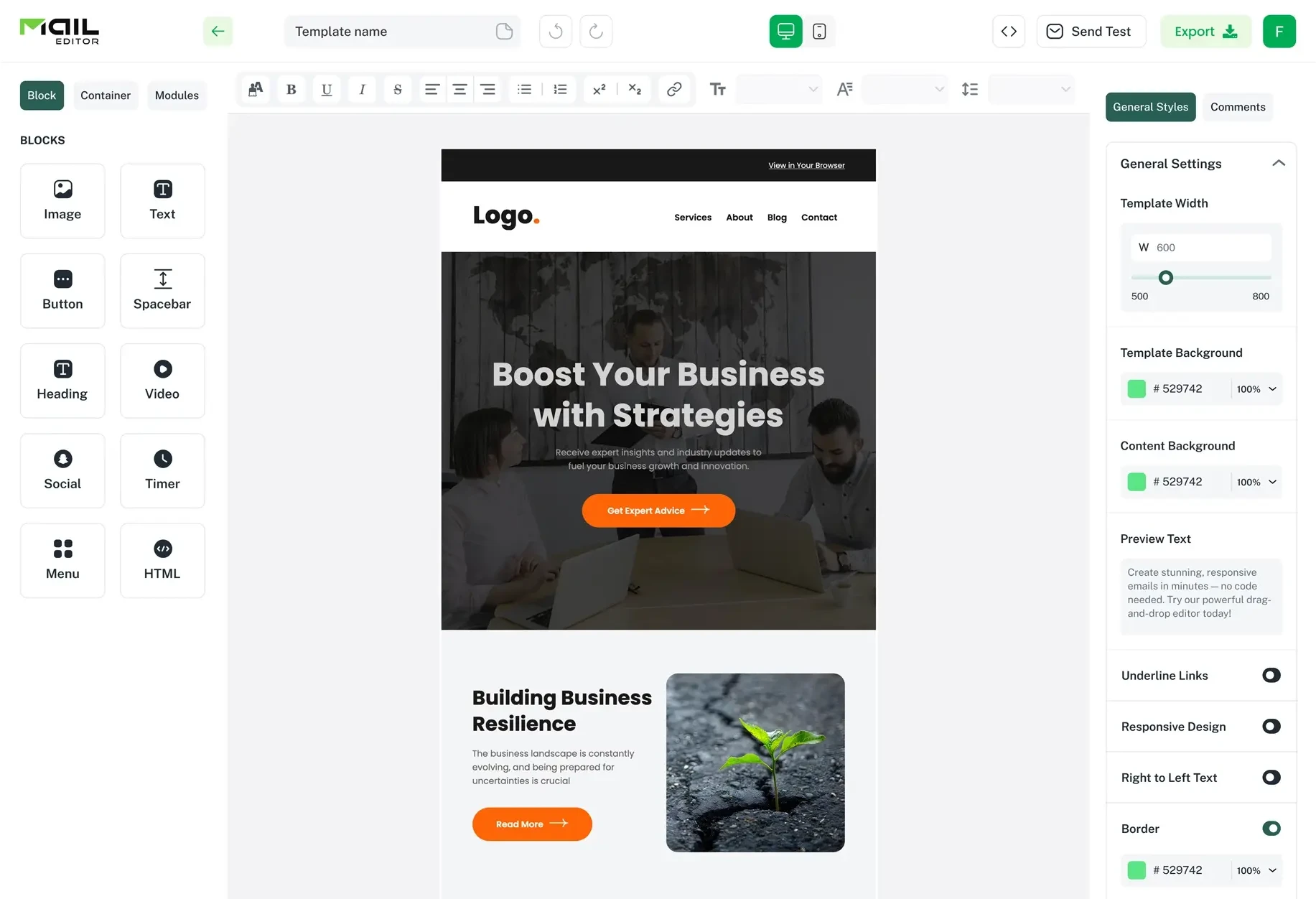
Top Email Template Builders & HTML Email Editors for 2026
Compare the best email template builders and HTML editors to design professional, responsive campaigns without coding.
Email Design9 mins to read
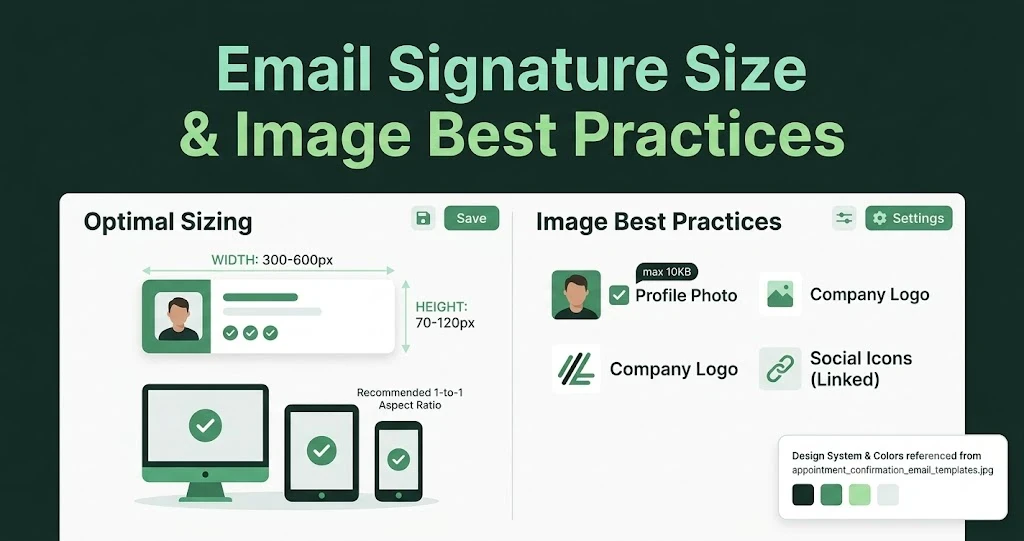
Email Signature Size and Image Best Practices
The ideal email signature is 320–600px wide and 90–200px high. Learn the best image sizes, formats, file limits, and mobile-friendly design tips.

Email Tips7 mins to read
Best Drag and Drop Email Editors in 2026
Discover the best drag and drop email editors in 2026. Compare top tools, features, templates, pricing, and automation to build stunning emails fast.

Marketing7 mins to read
4 Best Unlayer Alternatives to Design Emails
Looking for Unlayer alternatives? Explore the 4 best email design tools to create beautiful, responsive emails faster and easier.

Marketing6 mins to read
5 Beefree Alternatives to Upgrade Email Design Workflows
Looking for a better email design tool? Explore 5 Beefree alternatives that streamline workflows, improve collaboration, and elevate email campaigns.