What Makes a Free HTML Email Template Worth Using?
Free HTML email templates are worth using when they’re responsive, customizable, accessible, and email-client ready. See what to check before choosing one.

Md. Yaikub Hossain Razon
Free HTML email templates are worth using when they provide responsive layouts, flexible customization, clear content hierarchy, accessible design, and reliable email-client compatibility. A strong template should also match your campaign goal, support your branding, and fit smoothly into the email workflow your team already uses.
MailEditor provides a large collection of HTML email templates for newsletters, ecommerce, onboarding, events, transactional messages, promotions, and other campaign types. Meanwhile, Can I Email tracks hundreds of HTML and CSS features across major email clients, showing why technical structure matters as much as visual design.
This guide is for marketers, designers, founders, and email teams choosing a reliable template. You will learn what separates a useful free template from one that simply looks attractive in a preview.
What Makes a Good HTML Email Template?
A good HTML email template combines responsive structure, flexible customization, clear hierarchy, accessible design, useful campaign sections, and email-friendly HTML. It should give you a professional starting point without forcing your campaign into a rigid layout.
A polished preview is useful.
However, the real value appears when you begin customizing the template.
You should be able to:
-
Replace the logo
-
Change brand colors
-
Edit typography
-
Replace images
-
Rewrite the copy
-
Update links
-
Change CTA buttons
-
Add or remove sections
-
Adjust spacing
-
Adapt the layout to your campaign
A good HTML email template should feel like a flexible starting system.
It should not require you to rebuild the entire email whenever your content changes.
Why Responsive HTML Email Templates Matter
Responsive HTML email templates adapt their layout for different screen sizes while keeping the message readable and actionable. Images, columns, text, spacing, and buttons should behave sensibly when the email moves from a desktop inbox to a smaller mobile screen.
Responsive email design involves more than shrinking the email width.
A strong responsive template considers:
-
Column stacking
-
Image scaling
-
Font readability
-
Button size
-
Horizontal spacing
-
Content order
-
Mobile alignment
-
Navigation behavior
Google documents support for media queries and many CSS properties within Gmail.
However, support still varies between email clients.
Can I Email tracks HTML and CSS support across:
-
Gmail
-
Outlook
-
Apple Mail
-
Yahoo Mail
-
Samsung Email
-
Proton Mail
-
Thunderbird
-
Other email clients
That is why a template designed specifically for email provides a better starting point than a regular webpage layout.
How Customizable Should It Be?

Customizable email templates should let you change campaign content and brand styling without rebuilding the entire design. At minimum, you should be able to edit text, images, colors, logos, links, buttons, backgrounds, and major content sections.
A useful template should support your brand.
It should not force every campaign to look exactly like the original sample.
Look for editable:
-
Brand colors
-
Logo areas
-
Headlines
-
Body copy
-
Images
-
CTA labels
-
CTA URLs
-
Backgrounds
-
Content sections
-
Spacing
Layout flexibility also matters.
Imagine a product promotion template contains four product cards.
Your campaign only needs two.
A flexible template should let you remove the extra sections while keeping the overall layout balanced.
You may also want to add:
-
Testimonial
-
Promo banner
-
Social section
-
Secondary CTA
-
Product feature
-
Footer variation
MailEditor lets you start with free HTML email templates and customize the design for your own campaign.
Does Email Compatibility Matter?
Yes. A useful HTML email template should use structures designed to work reliably across common inbox environments. Email clients support HTML and CSS differently, so a template should use email-friendly code rather than relying only on modern web-development techniques.
Can I Email tracks hundreds of HTML and CSS features across major email clients.
These include:
-
Apple Mail
-
Gmail
-
Outlook
-
Yahoo Mail
-
Samsung Email
-
Proton Mail
-
Thunderbird
-
Fastmail
You do not need to inspect every CSS property manually.
Instead, look for templates created specifically for email.
Then test the finished campaign after customization.
This matters because your changes can affect:
-
Images
-
Spacing
-
Content length
-
Fonts
-
Columns
-
Buttons
-
Dynamic content
The final email is what recipients will see.
For a broader QA process, read MailEditor’s guide on how to test email templates across devices.
What Makes the Layout Effective?
A useful email template should guide readers through the message in a clear order. The main headline, supporting information, visual content, and CTA should be easy to identify without requiring the reader to study the entire email.
A simple structure might look like:
Headline → Supporting Message → Main Visual → CTA → Supporting Content
The ideal structure depends on the campaign.
Newsletter
A newsletter might use:
Header → Introduction → Featured Story → Secondary Stories → CTA → Footer
Ecommerce Promotion
An ecommerce campaign might use:
Header → Offer → Hero → Product Grid → CTA → Footer
Event Email
An event email might use:
Header → Event Title → Date and Time → Benefits → Registration CTA → Footer
There is no single layout that fits every campaign.
The template should match the message and desired action.
Does the Template Fit Your Goal?
The right template should support the action you want recipients to take. Newsletters, ecommerce promotions, onboarding emails, event invitations, transactional emails, and product announcements require different content structures.
Before selecting a template, answer these questions:
-
What is the main purpose of the email?
-
What should the recipient notice first?
-
What action should the recipient take?
-
How much content needs to appear?
-
Does the campaign need products, articles, event details, or account information?
Then select the template.
For example, a product launch may need a strong hero and product section.
A newsletter needs more space for multiple content blocks.
An event invitation should make date, time, location, and registration details easy to find.
Starting with the right structure can reduce unnecessary editing later.
How Important Is Accessibility?
Accessibility should be part of a good HTML email template from the beginning. Strong templates provide readable text, useful content order, clear links, appropriate color contrast, and room for image alt text.
WCAG 2.2 recommends a minimum contrast ratio of 4.5:1 for normal text and 3:1 for qualifying large text at Level AA.
When reviewing HTML email template examples, look for:
-
Readable body text
-
Clear headings
-
Descriptive CTA labels
-
Sufficient color contrast
-
Logical reading order
-
Image alt text support
-
Useful link text
Accessibility becomes easier to maintain when the starting template already encourages good design practices.
Should Templates Use Live Text?
Important campaign copy should remain live, editable text whenever practical. Live text is easier to update, remains available when images are unavailable, and provides more flexibility when adapting the template for different campaigns.
Consider a promotional banner.
One version contains all the content inside one graphic:
30% Off Everything — This Weekend Only — Shop Now
Another version uses:
-
Background image or color
-
Live HTML headline
-
Live supporting copy
-
HTML CTA button
The second approach gives marketers more editing flexibility.
You can update:
-
Discount
-
Headline
-
Date
-
CTA
-
Destination
without rebuilding the entire graphic.
A good HTML email template balances visual design with editable content.
What Makes a Good CTA?
A strong HTML email template should make its main action easy to recognize and customize. CTA sections need clear labels, useful contrast, enough spacing, and a logical connection to the content that comes before them.
The button should clearly communicate what happens next.
Examples include:
-
Shop the collection
-
Reserve your seat
-
Read the guide
-
View product
-
Start free trial
-
Explore new arrivals
-
See event details
Customizable email templates should also let you change:
-
Button label
-
Destination URL
-
Alignment
-
Background color
-
Text color
-
Spacing
CTA flexibility matters because different campaigns have different objectives.
Should Templates Support Branding?
A good free template should make brand customization straightforward. You should be able to replace sample styling with your own logo, colors, typography, imagery, tone, and campaign content while preserving a polished structure.
Look for editable:
-
Logo
-
Brand colors
-
Background colors
-
Typography
-
Images
-
Button styles
-
Footer information
Do not choose a template only because the sample colors match your brand.
Instead, ask whether those styles can be changed easily.
The best free email templates are flexible enough to become part of your own visual system.
Does Clean HTML Matter?
Yes. The HTML behind an email template affects how easily the design can be edited, exported, maintained, and rendered. Email-ready HTML should use structures created for inbox environments rather than ordinary website layouts.
Google’s Gmail documentation explains the supported CSS properties, selectors, and media queries available for email.
This makes email-specific HTML important.
You do not need to become a developer to evaluate every template.
Instead, look for useful signals:
-
Designed specifically for email
-
Responsive structure
-
Editable HTML
-
Clear content blocks
-
Sensible fallbacks
-
Flexible export
-
Tested layout patterns
If you want to work with HTML designs visually, MailEditor also explains how to edit HTML email templates without coding.
Does Export Flexibility Matter?
A useful free HTML email template should fit into the email workflow your team already uses. If you design in one platform and send from another, portable HTML or supported export options can make the template much more practical.
A common workflow may look like:
Choose Template → Customize → Preview → Export HTML → Import to ESP → Test → Send
Another workflow may be:
Choose Template → Customize → Export to Platform → Final Test → Send
The template should support your workflow.
Your workflow should not need to change just to accommodate the template.
The MailEditor HTML email builder lets you visually customize HTML email designs before preparing them for your sending workflow.
Free HTML Email Template Scorecard
Use this practical 20-point quality scorecard when comparing templates.

Give each category:
0 = Not included
1 = Partly covered
2 = Strongly covered
|
Quality Check |
What to Look For |
Score |
|
Responsive design |
Desktop and mobile-friendly layout |
0–2 |
|
Email compatibility |
Built for common inbox environments |
0–2 |
|
Customization |
Editable copy, colors, images, and links |
0–2 |
|
Brand flexibility |
Logo, typography, colors, and styles |
0–2 |
|
Content hierarchy |
Clear headline, message, and CTA |
0–2 |
|
Accessibility |
Contrast, alt text, readable structure |
0–2 |
|
Live text |
Important copy stays editable |
0–2 |
|
CTA usability |
Clear and customizable action areas |
0–2 |
|
Export flexibility |
Works with your sending workflow |
0–2 |
|
Reusability |
Can support future campaigns |
0–2 |
How to Read the Score
17–20: Strong starting template
13–16: Good template with some campaign-specific refinement
9–12: Review whether additional customization fits your workflow
0–8: Consider a template that already matches more of your requirements
This scoring method is a practical MailEditor evaluation framework for this guide.
It is not an industry-standard certification.
The goal is to compare usability, structure, and flexibility rather than visual appearance alone.
HTML Email Template Examples
The qualities of a strong template become clearer when you apply them to different campaign types.
Newsletter Template

A good newsletter template may include:
-
Header
-
Introductory section
-
Featured article
-
Repeatable article cards
-
Clear links
-
CTA section
-
Footer
The template should also let you add or remove article sections.
E-commerce Template

A good ecommerce template may include:
-
Promotional banner
-
Hero image
-
Offer headline
-
Product cards
-
Pricing
-
CTA buttons
-
Shipping information
-
Footer
Product sections should remain readable on smaller screens.
Welcome Email Template
A welcome email should keep the first message focused.
It may include:
-
Brand introduction
-
Welcome headline
-
Short explanation
-
Main benefit
-
Primary CTA
-
Helpful resources
-
Footer
Event Email Template
A useful event email should make important information easy to find.
Look for:
-
Event name
-
Date
-
Time
-
Location
-
Speaker information
-
Agenda
-
Registration CTA
-
Footer
These examples show why campaign fit matters.
The most visually attractive template is not automatically the best template for every email.
How to Choose Free HTML Email Templates
Choose free HTML email templates by starting with campaign purpose, then reviewing responsiveness, customization, hierarchy, accessibility, compatibility, and export options. This keeps the decision focused on practical campaign needs.
Follow this process:
-
Define the campaign goal.
-
Choose the right template category.
-
Preview the desktop layout.
-
Check the mobile layout.
-
Review content hierarchy.
-
Confirm text is editable.
-
Confirm images can be replaced.
-
Check branding flexibility.
-
Review CTA structure.
-
Confirm export options.
-
Add your real content.
-
Add alt text.
-
Preview the final campaign.
-
Send a test.
-
Review the email before launch.
This process works for:
-
Newsletter
-
Product promotion
-
Event invitation
-
Onboarding email
-
Customer update
-
Transactional email
-
Seasonal campaign
Are Free HTML Email Templates Worth Using?
Yes. Free HTML email templates are worth using when they provide a strong technical foundation and enough flexibility for your campaign. A good template can reduce setup work while still allowing you to customize branding, copy, imagery, CTAs, links, and content sections.
The word “free” describes the starting cost.
It should not be your only evaluation criterion.
Quality also depends on:
-
Responsive behavior
-
Customization
-
Campaign fit
-
Accessibility
-
Code structure
-
Compatibility
-
Testing
-
Export options
A template becomes valuable when it makes your production workflow easier while still supporting your campaign goals.
What Should You Check Before Sending?
Always test the final customized template rather than relying only on the original preview. Your own content can affect spacing, image dimensions, mobile stacking, CTA placement, links, personalization, and other parts of the finished email.

Before sending, check:
-
Subject line
-
Preheader
-
Logo
-
Headlines
-
Body copy
-
Images
-
Alt text
-
CTA buttons
-
CTA links
-
Mobile layout
-
Desktop layout
-
Footer information
-
Unsubscribe link
-
Personalization
-
Final destination URLs
The template provides the foundation.
The customized campaign is the version that matters.
Final Answer
A free HTML email template is worth using when it saves setup time while giving you a strong foundation for a professional campaign.
Look for:
-
Responsive structure
-
Flexible customization
-
Clear content hierarchy
-
Brand flexibility
-
Accessible design
-
Editable live text
-
Clear CTA sections
-
Email-friendly HTML
-
Flexible export options
-
A layout that matches the campaign goal
Do not select a template based only on appearance.
Choose one that supports the email you actually need to create.
Then customize it, add your branding, review accessibility, and test the finished campaign.
Explore the MailEditor HTML email template library to find layouts for newsletters, promotions, ecommerce, onboarding, events, transactional messages, and other campaigns.
Frequently Asked Questions
Question: What are free HTML email templates?
Answer: Free HTML email templates are pre-designed email layouts that provide a reusable HTML structure for newsletters, ecommerce, onboarding, events, transactional messages, promotions, and other campaigns. A strong template lets you customize content and branding while keeping an email-friendly responsive foundation.
Question: What makes a good HTML email template?
Answer: A good HTML email template combines responsive design, clear content hierarchy, customizable sections, accessible styling, useful CTA areas, and email-friendly code. It should also match the campaign goal and remain practical after replacing the sample content with your own branding and message.
Question: Are free HTML email templates responsive?
Answer: Many modern free HTML email templates are responsive, but responsiveness should still be checked before use. Preview the design on desktop and mobile, review how columns stack, inspect image scaling and buttons, and test the customized version before sending it to subscribers.
Question: Can I customize free HTML email templates?
Answer: Yes. Customizable email templates can let you replace text, logos, images, colors, links, buttons, backgrounds, spacing, and content sections while keeping the underlying structure. The exact editing options depend on the template and the email editor you use.
Question: Do I need HTML knowledge to use email templates?
Answer: Not necessarily. Visual email editors allow marketers to update text, images, buttons, colors, sections, and other design elements without manually editing HTML. HTML access can still be useful when a developer wants to make more advanced technical changes.
Question: How do I know if an HTML email template is good?
Answer: Check whether the template is responsive, customizable, easy to brand, accessible, clearly structured, designed for email clients, and compatible with your sending workflow. Then add your real content and test the finished campaign on the devices and inboxes important to your audience.
Question: What are the best free email templates?
Answer: The best free email templates are those that match your campaign goal while providing responsive structure, editable content, strong hierarchy, brand flexibility, accessible design, clear CTAs, and practical export options. The right template depends on the type of email you need to send.
Question: Can I use MailEditor free HTML email templates?
Answer: Yes. MailEditor provides HTML email templates for newsletters, ecommerce, onboarding, events, transactional messages, promotions, and other campaign types. You can select a suitable layout, customize the content and branding visually, and prepare the completed design for your email workflow.
Popular Blogs
Email Design2 mins to read
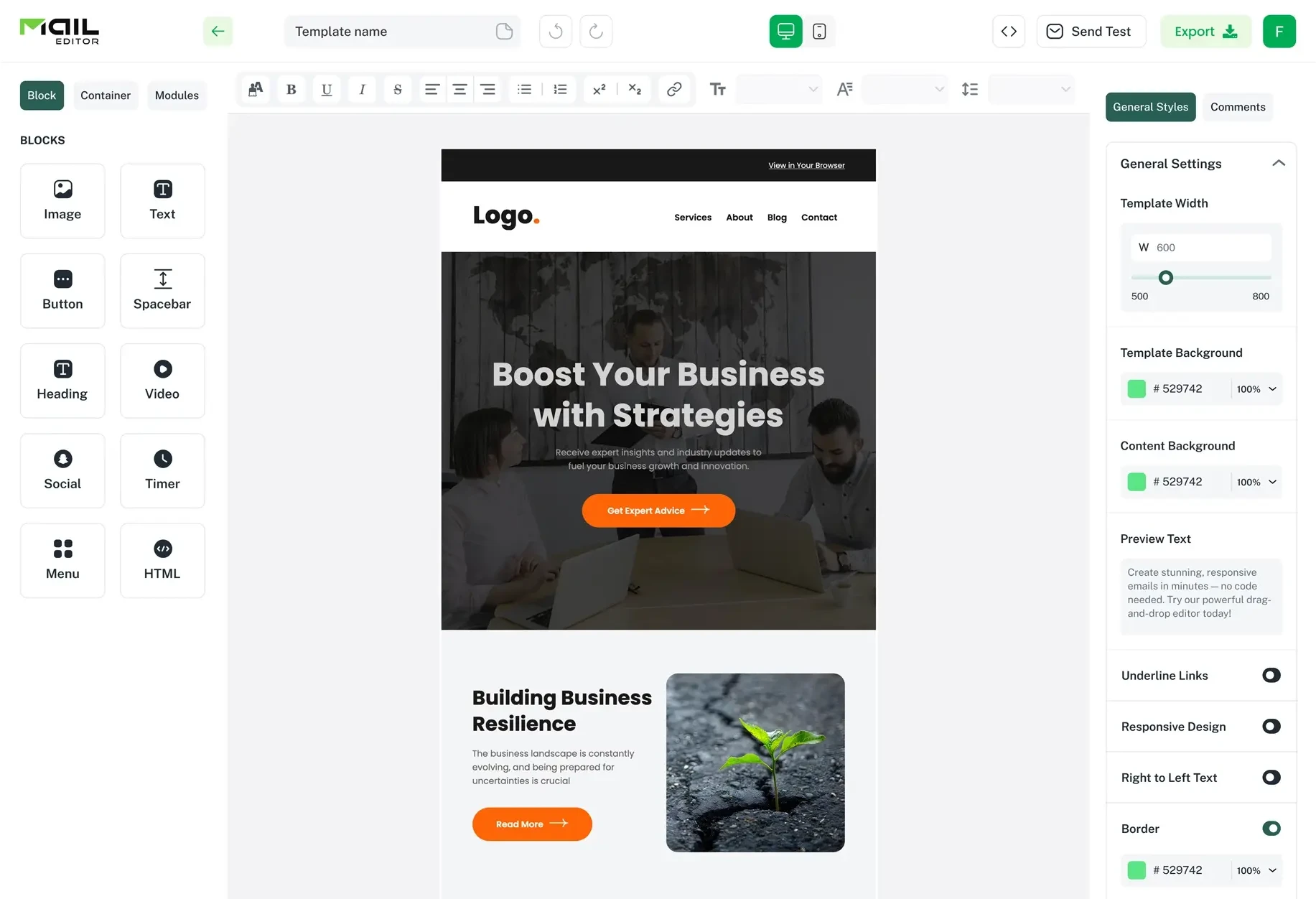
Top Email Template Builders & HTML Email Editors for 2026
Compare the best email template builders and HTML editors to design professional, responsive campaigns without coding.

Email Tips7 mins to read
Best Drag and Drop Email Editors in 2026
Discover the best drag and drop email editors in 2026. Compare top tools, features, templates, pricing, and automation to build stunning emails fast.
Email Design9 mins to read
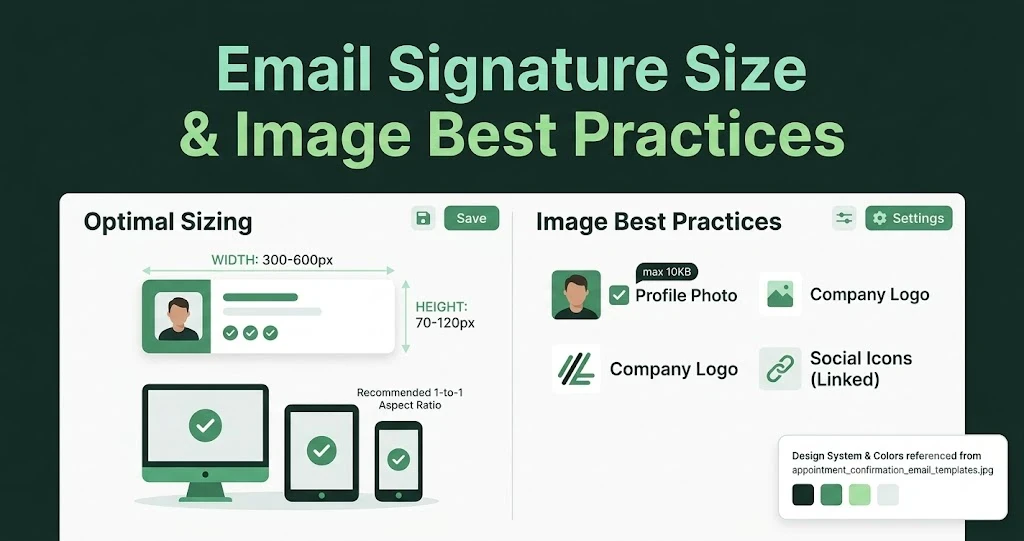
Email Signature Size and Image Best Practices
The ideal email signature is 320–600px wide and 90–200px high. Learn the best image sizes, formats, file limits, and mobile-friendly design tips.
Marketing7 mins to read
4 Best Unlayer Alternatives to Design Emails
Looking for Unlayer alternatives? Explore the 4 best email design tools to create beautiful, responsive emails faster and easier.

Marketing6 mins to read
5 Beefree Alternatives to Upgrade Email Design Workflows
Looking for a better email design tool? Explore 5 Beefree alternatives that streamline workflows, improve collaboration, and elevate email campaigns.