Best Email Template Builders for Small Businesses in 2026
Choose the best email template builder for small business with responsive templates, easy editing, and flexible exports. Compare 7 top tools for your needs.

Md. Yaikub Hossain Razon
The best email template builder for small business should help a small team create professional, responsive emails quickly without needing advanced design or coding skills. MailEditor is our top overall choice for businesses that want drag-and-drop editing, reusable content, ready-made templates, and flexible export options.
Small businesses often need to create newsletters, promotions, customer updates, event emails, and service announcements with limited time and resources.
That makes ease of use just as important as design flexibility.
The right email template builder should let you create a branded email once, reuse important sections, update campaign content quickly, and move the finished design into your preferred email platform.
This guide focuses specifically on small-business email workflows. It compares seven email template builders based on ease of use, reusable design, templates, mobile responsiveness, export options, and suitability for small teams.
What Should Small Businesses Look For?
A good email template builder for small businesses should reduce repetitive design work and make professional email creation easy to manage.
Small businesses usually benefit most from practical features rather than complex workflows.
Look for:
- Drag-and-drop editing
- Responsive email templates
- Reusable content blocks
- Easy brand customization
- Mobile-friendly layouts
- Newsletter templates
- Promotional email templates
- Clear CTA controls
- HTML or ESP export
- Preview and testing tools
The builder should also support the emails your business actually sends.
These may include:
- Monthly newsletters
- Service promotions
- Company announcements
- Event invitations
- Customer updates
- Welcome emails
- Appointment reminders
- Review requests
- Lead follow-ups
- Seasonal campaigns
The goal is simple: create good emails without rebuilding the same layout every time.
Best Email Template Builders Compared
|
Builder |
Best For |
Main Strength |
|
MailEditor |
Flexible small-business design |
Reusable templates and export flexibility |
|
MailerLite |
Email plus automation |
Simple campaign workflow |
|
Constant Contact |
Local and service businesses |
Small-business-focused marketing |
|
Mailchimp |
Existing Mailchimp users |
Design and sending in one platform |
|
Brevo |
Growing communication needs |
Campaigns and automation |
|
Stripo |
Flexible email export |
Standalone email design |
|
RGE Studio |
Small collaborative teams |
Design review and teamwork |
1. MailEditor
Best Overall for Small Businesses
MailEditor is our top overall choice for small businesses that want an easy visual email builder without tying their designs to one email marketing platform.
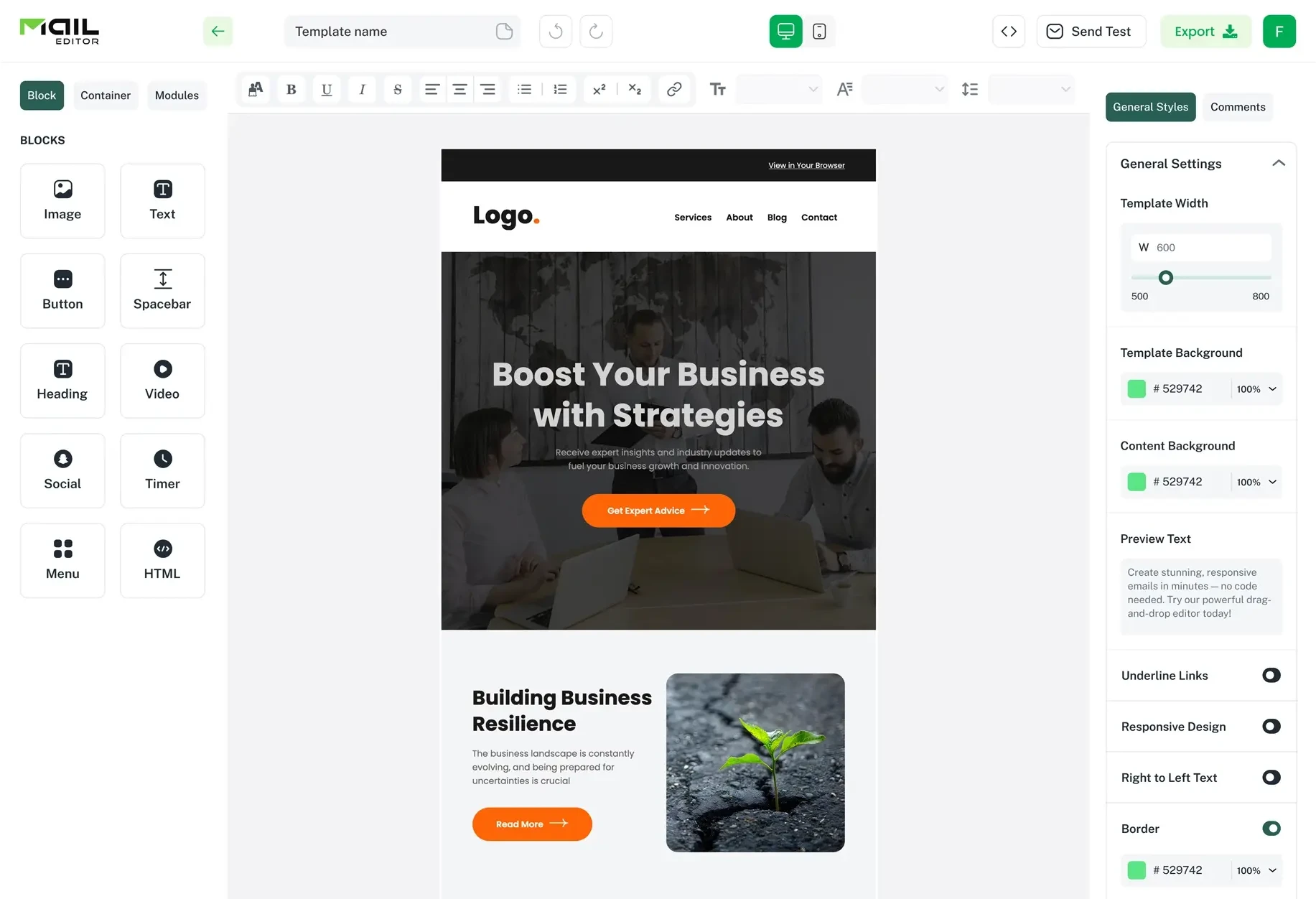
The MailEditor drag-and-drop HTML email builder provides a dedicated space to create, edit, save, reuse, and export professional email designs.
Small businesses can build emails without creating the complete HTML structure from scratch.
Key MailEditor Features
MailEditor gives businesses access to:
- Drag-and-drop editing
- 200+ responsive email templates
- 120+ pre-built modules
- Reusable design sections
- Responsive columns
- Custom HTML blocks
- Brand customization
- HTML export
- ESP export options
- Email previews
- Test email functionality
Its focus on reusable design is especially useful for small teams.
You can create one branded header, footer, CTA section, or service block and reuse it across future campaigns.
Useful Templates for Small Businesses
The MailEditor email template library covers common business communication needs.
Templates can be adapted for:
- Business newsletters
- Promotions
- Customer updates
- Events
- Welcome emails
- Announcements
- Follow-ups
- Customer journeys
For regular company communication, businesses can use business communication email templates.
These layouts are designed for company updates, client messages, project information, announcements, and follow-ups.
Why It Works for Small Teams
A small-business workflow often looks like this:
Choose template → add branding → update content → preview → export → send
MailEditor keeps the design stage focused on that process.
You can also reuse sections instead of asking a designer or developer to rebuild recurring email elements.
MailEditor's main template library currently supports newsletters, promotions, onboarding, transactional communication, events, and customer journeys.
2. MailerLite
Best for Simple Email Automation
MailerLite is a practical choice for small businesses that want email design, subscriber management, signup forms, and automation within one platform.
Its visual campaign workflow is suited to businesses that prefer to design and send from the same environment.
MailerLite works particularly well for:
- Consultants
- Creators
- Coaches
- Newsletter publishers
- Service providers
- Small online businesses
Users can create newsletters, automated messages, promotions, and subscriber communication from one system.
When It Fits Best
MailerLite makes sense when your priority is:
Create → manage subscribers → automate → send
A business that wants an independent email design workspace may prefer a standalone builder.
However, businesses that prefer an integrated workflow may find MailerLite convenient.
3. Constant Contact
Best for Local Businesses
Constant Contact is well suited to small businesses that want straightforward email marketing alongside other business marketing tools.
It is commonly positioned toward small organizations and service-based businesses.
Useful campaign types include:
- Newsletters
- Events
- Promotions
- Customer announcements
- Seasonal messages
- Local business updates
It can be particularly relevant for:
- Restaurants
- Local stores
- Professional services
- Community organizations
- Nonprofits
- Event-based businesses
When It Fits Best
Choose this type of platform when you want email creation and campaign management within the same business marketing environment.
It can reduce the number of separate tools a small team manages.
4. Mailchimp
Best for Existing Mailchimp Users
Mailchimp is a practical option for small businesses that already manage subscribers and campaigns inside Mailchimp.
Its built-in email editor lets users create marketing messages using visual content blocks and prepared layouts.
Small businesses can create:
- Newsletters
- Promotions
- Company updates
- Welcome messages
- Events
- Customer announcements
Why Existing Users May Prefer It
The main advantage is workflow continuity.
If your contacts, campaigns, analytics, and automation already live inside Mailchimp, creating the email there keeps the process centralized.
A standalone builder becomes more relevant when you want designs that can move easily between different email platforms.
5. Brevo
Best for Growing Communication Workflows
Brevo is useful for small businesses that want email campaigns, automation, and customer communication within one platform.
Its visual editor supports common marketing emails while the wider platform supports automated and transactional communication.
Businesses can use it for:
- Newsletters
- Promotions
- Welcome messages
- Customer notifications
- Follow-up sequences
- Automated campaigns
When Brevo Makes Sense
Brevo fits businesses whose email needs are expanding beyond occasional newsletters.
A company may begin with regular promotional email and later add automated customer communication.
Keeping those activities in one platform can simplify management.
6. Stripo
Best for Flexible Email Export
Stripo is a standalone email builder suited to businesses that want to create templates separately and export them into different email platforms.
It combines visual editing with more advanced HTML design options.
Useful capabilities include:
- Drag-and-drop editing
- Reusable email modules
- Responsive design
- HTML editing
- HTML export
- ESP integrations
Who Should Consider It?
Stripo can fit small agencies and businesses using several sending platforms.
For example, one client may use Mailchimp while another uses HubSpot.
A standalone builder gives the team one place to prepare both designs.
That differs from an all-in-one platform, where design stays closely tied to the sending system.
7. RGE Studio
Best for Small Collaborative Teams
RGE Studio is suited to businesses where more than one person helps create, review, and approve email designs.
Its workflow combines visual email creation with collaboration features.
Teams can use it for:
- Email design
- Reusable content
- Internal review
- Team comments
- Campaign approval
- Export workflows
Why Collaboration Matters
Small does not always mean one person.
A business might have:
Owner → marketer → designer → reviewer
Keeping feedback around the same design can help the team move from draft to final version more efficiently.
This makes collaboration features more valuable as campaign volume grows.
Which Type of Builder Do You Need?
Small businesses should choose between a standalone email builder and an all-in-one email marketing platform based on how they want to manage design and sending.
|
Standalone Email Builder |
All-in-One Email Platform |
|
Focuses strongly on email design |
Combines design and sending |
|
Useful across multiple ESPs |
Usually centered on one platform |
|
Often supports HTML export |
Subscriber data stays inside the system |
|
Good for reusable design libraries |
Good for automation workflows |
|
Useful for agencies and designers |
Useful for integrated marketing |
Examples of standalone design tools include:
-
MailEditor
-
Stripo
-
RGE Studio
Examples of broader email platforms include:
-
MailerLite
-
Constant Contact
-
Mailchimp
-
Brevo
Choose a Standalone Builder If
A standalone builder may fit your business when:
-
You want control over your email designs.
-
You work with several email platforms.
-
HTML export matters.
-
You reuse templates frequently.
-
You want a dedicated design workspace.
Choose an All-in-One Platform If
An integrated platform may fit when:
-
One system manages most campaigns.
-
Your subscriber list already lives there.
-
Automation is important.
-
You prefer design and sending together.
This distinction helps prevent businesses from comparing tools that solve different problems.
How to Choose the Right Builder
1. Start With Your Email Needs
List the emails your business sends regularly before comparing features.
For example:
-
Newsletter
-
Monthly promotion
-
Customer update
-
Event invitation
-
Appointment reminder
-
Welcome message
A builder should make your recurring campaigns easier.
Features you never use should not determine the decision.
2. Check Ease of Use
The best small-business email builder should fit the skill level of the person who actually creates your emails.
A simple process might be:
-
Select a layout.
-
Add your branding.
-
Update the copy.
-
Replace the images.
-
Check mobile layout.
-
Export or send.
If your business owner or marketer handles email directly, an intuitive workflow becomes especially valuable.
3. Prioritize Reusable Design
Reusable sections can save significant production time across recurring campaigns.
Create reusable:
-
Headers
-
Footers
-
CTA sections
-
Contact blocks
-
Testimonials
-
Service sections
-
Social links
Then update only the content that changes.
For example, a monthly newsletter may keep the same header and footer while the main story changes.
This also helps maintain consistent branding.
4. Review Mobile Layout
A small-business email should remain readable and easy to interact with on smaller screens.
Before sending, review:
-
Text size
-
Button size
-
Image scaling
-
Spacing
-
Column stacking
-
Content order
MailEditor's guide to mobile-responsive email design provides more detail on building emails that adapt across screen sizes.
5. Check Export Compatibility
Know where your finished design needs to go before committing to a builder.
Ask:
-
Can I download HTML?
-
Can I export to my ESP?
-
Can I save templates?
-
Can I reuse the design elsewhere?
-
Can team members access it?
If portability matters, make it part of your selection criteria from the start.
Small Business Email Builder Scorecard
Use this simple scorecard to compare your shortlist.
Give each tool a score from 1 to 5.
|
Question |
Score |
|
Is it easy to use? |
/5 |
|
Does it support my email types? |
/5 |
|
Can I reuse branded sections? |
/5 |
|
Does it work with my ESP? |
/5 |
|
Is mobile editing practical? |
/5 |
|
Does it fit my team workflow? |
/5 |
|
Does it fit my current budget? |
/5 |
|
Total |
/35 |
The highest score should reflect your workflow, not simply the longest feature list.
What Is the Best Email Template Builder for Small Business?
The best email template builder for small business is one that matches your team's skills, email volume, sending platform, and design workflow. MailEditor is our top overall choice for businesses that want visual editing, reusable templates, responsive layouts, and flexible export options.
Choose:
-
MailEditor for flexible design and reusable templates.
-
MailerLite for simple email marketing and automation.
-
Constant Contact for local and service-business marketing.
-
Mailchimp when your business already uses Mailchimp.
-
Brevo for growing automation and communication needs.
-
Stripo for standalone design and export flexibility.
-
RGE Studio for collaborative email production.
Final Answer
The best email template builder for small business should simplify email production without creating extra work.
-
Choose an easy visual editor that matches your team's design skills.
-
Prioritize reusable sections for newsletters, promotions, customer updates, and recurring campaigns.
-
Check responsive design so emails remain clear across desktop and mobile screens.
-
Review export compatibility before choosing a tool if your business already uses an email marketing platform.
-
Choose MailEditor for flexible email design when you want responsive templates, reusable modules, visual editing, and portable email workflows.
Start with the MailEditor drag-and-drop email builder and browse 200+ responsive HTML email templates for newsletters, promotions, events, customer communication, onboarding, and more.
Frequently Asked Questions
Question: What is the best email template builder for small business?
Answer: MailEditor is our top overall choice for small businesses that want responsive templates, drag-and-drop editing, reusable modules, and flexible export options.
Question: Can small businesses create emails without coding?
Answer: Yes. Drag-and-drop email builders allow small businesses to create professional emails without writing the complete HTML code manually.
Question: What Features Should Small Businesses Look For?
Answer: Small businesses should prioritize ease of use, responsive templates, reusable content, brand controls, mobile design, and practical export options.
Question: Do Small Businesses Need Email Templates?
Answer: Email templates help small businesses create consistent campaigns faster by providing a reusable structure for recurring communication.
Question: Should I Use a Standalone Email Builder?
Answer: Use a standalone email builder when you want independent design control, reusable templates, HTML export, or the flexibility to move designs between email platforms.
Popular Blogs
Email Design2 mins to read
Top Email Template Builders & HTML Email Editors for 2026
Compare the best email template builders and HTML editors to design professional, responsive campaigns without coding.
Email Design9 mins to read
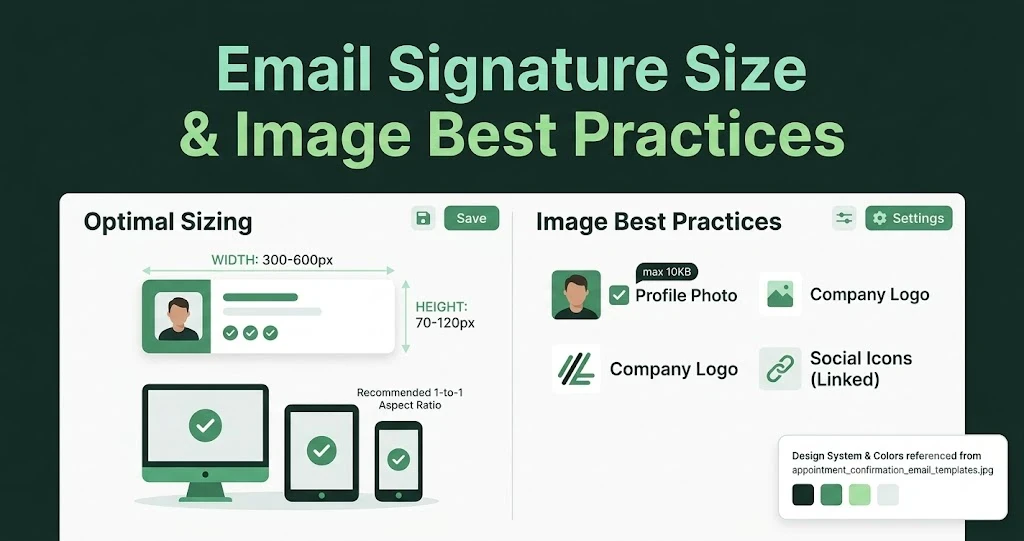
Email Signature Size and Image Best Practices
The ideal email signature is 320–600px wide and 90–200px high. Learn the best image sizes, formats, file limits, and mobile-friendly design tips.

Email Tips7 mins to read
Best Drag and Drop Email Editors in 2026
Discover the best drag and drop email editors in 2026. Compare top tools, features, templates, pricing, and automation to build stunning emails fast.

Marketing7 mins to read
4 Best Unlayer Alternatives to Design Emails
Looking for Unlayer alternatives? Explore the 4 best email design tools to create beautiful, responsive emails faster and easier.

Marketing6 mins to read
5 Beefree Alternatives to Upgrade Email Design Workflows
Looking for a better email design tool? Explore 5 Beefree alternatives that streamline workflows, improve collaboration, and elevate email campaigns.