Email Marketing for Financial Advisors: Trust, Reputation, Growth
Email marketing helps financial advisors engage clients, boost reputation, and generate consistent growth.

Shahin Alam
Here’s something that many financial advisors can relate to. During a weekday, the market takes a dip. You know that your clients are checking the news, and they open their inboxes right away.
Each email they receive can either calm their nerves, or deepen their anxiety.
These are the moments that make email marketing for financial advisors crucial. Here, it’s not about generating new leads.
It’s about building trust, reassuring clients, and stabilizing relationships.
As a financial advisor, you want to make the most of email marketing. It is a powerful tool that, by sending timely, thoughtful emails, can help stop your clients from making impulsive decisions.
With it, you can help reduce client stress and keep advisory relationships intact.
Email marketing works better than other channels. It lets you reach your client directly in their inbox, exactly when they need you.
It enables calm and consistent communication that allows you to guide, educate, and reassure your clients about their finances.
I have designed this blog to help financial advisors turn their email communications into structured engines that build trust and drive growth and revenue.
You will learn about client psychology, compliance considerations, and other mechanics of an effective email system.
By the end, you will have a blueprint for consistent and reliable communication, even when markets are turbulent.
Most Financial Advisors Miss a Silent Risk

When a market shifts unexpectedly, it triggers anxiety and uncertainty among clients. And it is perfectly understandable, too; after all, their valuable money is at risk.
As a financial advisor, you should immediately drop a message in their inbox and lower their stress.
One of the biggest don’ts of being a financial advisor is leaving gaps in communication. Yet many advisors do this exact thing, sometimes without even realizing it.
They send emails only sporadically, the messages feel generic, and respond late.
These acts leave clients in the dark and create a bad experience, especially for those who prefer written communication that they can revisit at a later time.
Consistent emails act as a safety net. It ensures ongoing communication, and well-timed messages deliver reassurance, showing clients that their financial plan is being actively monitored and managed.
Over time, these consistent emails build trust with clients, calm them down, and keep them engaged for long-term objectives.
Financial advisors who neglect this silent risk are likely to face real consequences.
- Clients experience increased anxiety, which can affect decision-making.
- They may make hasty withdrawals or changes to their portfolios.
- Your reputation suffers and destroys the trust you worked years to build.
If you recognize this gap early on, then congratulations.
You have already taken the first step towards building a system that maintains stability and client relationships, which gives you a head start over competitors who don’t realize the importance of email marketing.
Understanding the Psychology Behind Client Communication

When someone makes a big financial decision, they don’t do it instantly, in the moment. They take time to think it over and look at it from various angles before committing.
But when market shifts occur, fear and uncertainty can guide choices over logic.
This is where you can play a part in their decision making process with a well-timed email.
You see, understanding the psychology behind a client’s decisions helps you maintain stability and trust. Market swings can cause even the most seasoned investor to overreact.
At this point, a timely, thoughtful email from you, the financial advisor, can calm them down.
A well-worded email serves as a pause button when these doubts arise. It gives your clients context, perspective, and reassurance about their finances.
Unlike verbal communication, emails act as written records that they can revisit when stress levels spike.
Here are some key behavioral insights for financial advisors.
- A client’s emotional state affects decision-making and can lead to premature withdrawals or risky adjustments.
- Maintaining trust, clarity, and consistency in communication reduces churn and builds loyalty over time.
- Segmented messaging that is tailored to life stage and risk tolerance ensures clients receive information that matters most to them.
When a financial advisor like yourself understands these psychological triggers, it becomes easier to craft email strategies that are proactive and not reactive.
This turns email into a powerful tool that ensures stability and guidance, and gives you a steady authority.
Email Marketing for Financial Advisors as a Stability System

When professionals hear the term “email marketing,” most think of a tool that is used for acquisition or promotion. I disagree with this definition.
For financial advisors, email marketing is much more than that.
You should think of email marketing as a stability engine. When you use it right, you can reassure clients, preserve their portfolio stability and retention, maintain trust, and protect your reputation during market uncertainties.
A properly built email system delivers excellent outcomes that go beyond just open and click rates.
It lets advisors track client retention, encourage booking review meetings, increase referrals, and even maintain assets under management during volatile times.
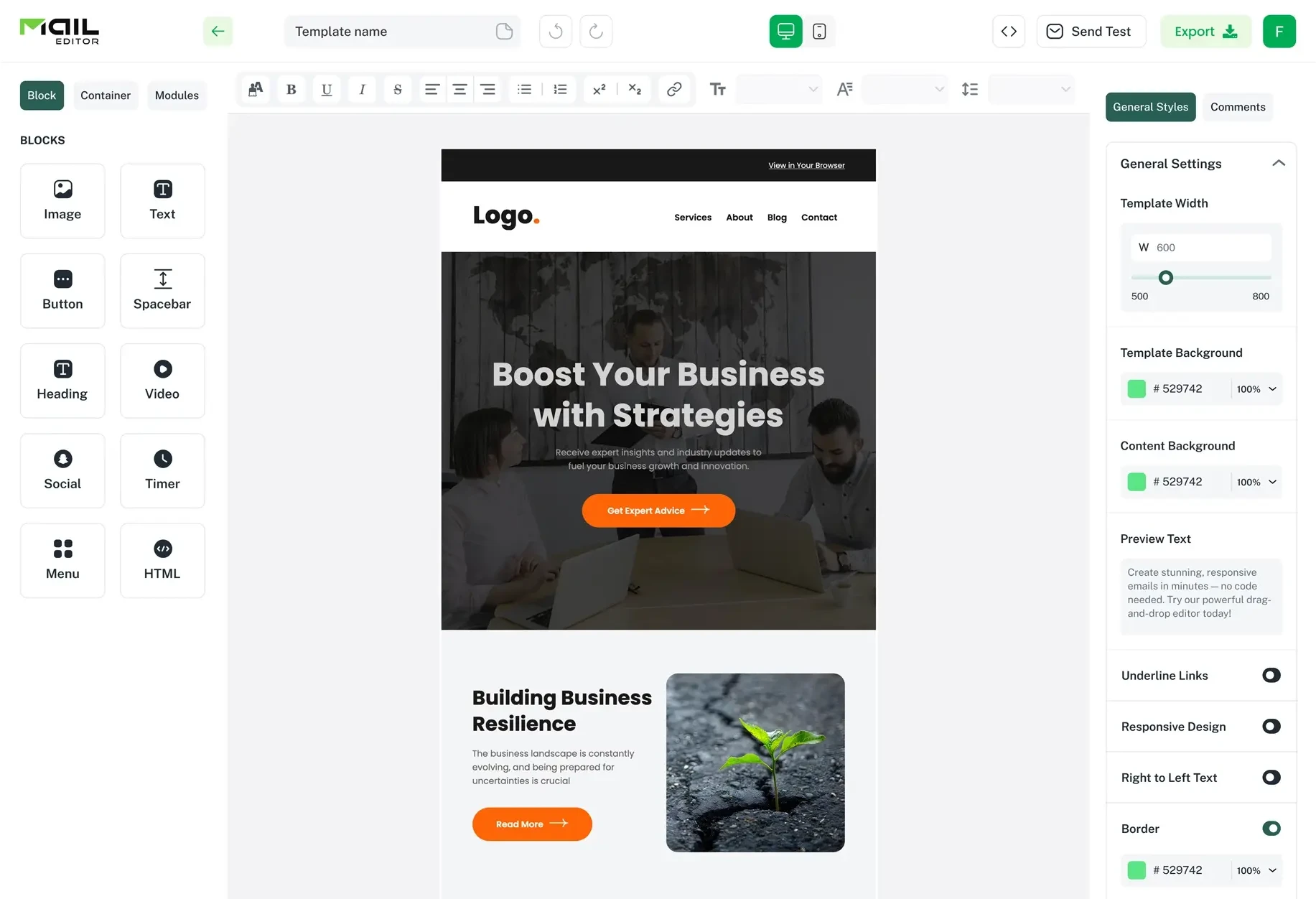
Tools like MailEditor simplify this process. You can use pre-designed templates to save time while ensuring your emails look professional and readable.
It also offers visual, drag-and-drop editing, making it suitable for all users, even ones without coding experience.
A strong stability system achieves several key goals.
- Consistent reassurance that give clients clear updates, reduce anxiety, and prevent rash decisions.
- Segmented and relevant content in personalized messages.
- Automated follow-ups that ensure sequences maintain communication without manual effort, keeping relationships active.
- Compliance-aligned communication so that emails meet regulatory requirements, protecting both clients and the advisor.
When you have such a system in place, it positions email as a core part of your practice and strengthens loyalty with customers, even in uncertain times.
How Advisor Communication Should Look Like

When you have multiple clients, not all of them will respond in the same way to market news of updates.
Each of them will have their own experience, risk tolerance, and emotional response. This means you can’t treat them all in the same way, or offer the same solution.
What’s the fix, then? Personalized email. You should send them messages that address their emotional state and financial priorities.
And one of the easiest ways to do this is with a communication matrix.
This table helps financial advisors find the right type of messaging, tone, and email frequency for different client groups, so that the emails are relevant, timely, and aligned with their individual needs.
| Client Type | Emotional State | Message Focus | What to Avoid | Frequency |
| Young Accumulators | Anxious about markets | Education, progress | Overly technical data | Monthly |
| Pre-Retirees | Nervous about income | Reassurance, action items | Vague wording | Biweekly |
| High Net-Worth | Fear of loss | Portfolio review | Alarming language | Weekly |
| Retirees | Concerned about withdrawals | Stability updates | Aggressive offers | Weekly |
This lets you approach email marketing as a deliberate strategy that is centered around clients, not a universal solution. And when you combine it with automated sequences and winning templates, you create a repeatable system that builds trust.
Compliance and Regulatory Requirements

Financial advisors have a tough job. They need to operate in a highly regulated environment, and email communications are no exception.
Even if you send an email that is meant to do well, it can create risk if it lacks proper disclosures, or isn’t archived correctly.
Some key regulatory requirements for financial advisors include the following.
- Archiving all emails for future reference
- Placing disclosures in appropriate locations
- Maintaining audit trails for reviews
You should take care not to ignore these rules and regulations, as doing so can lead to significant fines, broken trust with clients, and reputational damage.
Keep an eye on the email communication guidance provided by the Financial Industry Regulatory Authority (FINRA) and the SEC.
They emphasize that all messages sent to clients should be truthful, non-misleading, and properly documented.
This applies to automated campaigns, follow-ups, and templates.
Here are some practical tips for staying compliant with these rules.
- Use templates pre-approved by compliance teams to reduce errors.
- Place consistent content disclosures where they are visible and relevant for every message.
- Maintain email version control and archiving to provide evidence during audits or client inquiries.
When you maintain these practices, you can communicate confidently and effectively with your clients without risking compliance faults and errors.
It helps you build trust with clients and stay fully aligned with regulatory frameworks and expectations.
Building a Calm Communication Engine
So, now that you know about the importance of a communication engine, let’s look at how you can build one. It isn’t about simply sending generic updates.
It’s about building a strategic framework that reassures clients and keeps communication consistent.
A calm and effective communication engine requires clear planning, thoughtful design, and automation that satisfies both your client needs and the regulatory requirements.
I recommend financial advisors follow these steps.
1. Clarify Communication Goals
- Identify the purpose of each email sequence. Whether it’s reassurance, portfolio updates, or educational content, you should have a clear idea about it.
- Align your messages with measurable outcomes, such as booked reviews or reduced client anxiety.
- Prioritize clarity over volume of sending. This prevents your client from being overwhelmed by an overload of information.
2. Draft Reassurance Templates Before Market Events
- Prepare reassuring emails in advance for predictable scenarios, such as quarterly market reports.
- Use empathetic language to explain risks to your clients without causing alarm.
- Save these templates for repeated use in the future, ensuring consistency across client segments.
3. Build Automated Sequences By Client Segment
- Group your clients based on their defining factors, such as risk tolerance, life stage, or investment goals.
- Use automated sequences to deliver relevant content to your clients at the right time. This reduces manual effort and ensures your clients get updates in a timely manner.
- Include triggers for follow-ups, so that no client is left without a response.
4. Align Tone with Portfolio Risk and Client Personality
- Match your email’s messaging to each client’s comfort level and decision-making style.
- High-risk portfolios may require more frequent reassurance, while conservative clients may prefer stability updates.
- Keep the language in your message approachable and human.
Tools like MailEditor ease this process. It lets you create visually appealing and compliant emails quickly with its drag-and-drop email design capability, meaning you don’t have to deal with complex code.
These templates can be saved and reused across segments.
When you build such a system, your email communication becomes proactive rather than reactive.
You save time, your clients feel supported, and trust grows steadily even on days when the market is uncertain.
Common Advisor Mistakes That Undermine Trust

Even the most knowledgeable advisors can unintentionally damage their reputation with poor communication.
Trust is fragile, and a single misstep in email correspondence can leave a lasting impression.
As Warren Buffett once said, “It takes 20 years to build a reputation and five minutes to ruin it.”
This is especially true in financial advising, where client confidence is central to long-term relationships.
Mistakes like these can quickly erode trust.
Inconsistent Updates
Sending irregular or delayed emails leaves clients uncertain and anxious.
Generic, One-size-fits-all Emails
Messages that don’t address individual goals or risk tolerance feel impersonal and reduce engagement.
Ignoring Mobile Readability
Many clients check emails on phones; unreadable layouts or tiny fonts frustrate them and reduce response rates.
Overly Technical Language
Excessive jargon can confuse clients and make them feel excluded from their own financial decisions.
The consequences of miscommunication go beyond clicks or opens. Clients become increasingly anxious and make impulsive decisions, which can cause client retention to suffer.
Email strategy addresses these risks by ensuring timely, clear, and client-specific communication.
By avoiding these pitfalls and using templates, automation, and careful segmentation, advisors can maintain trust while keeping clients informed and confident.
Designing Emails That Instill Confidence
Email design goes beyond aesthetics. For financial advisors, it’s about creating a message that reassures clients and guides decisions without overwhelming them.
Thoughtful design can subtly reinforce trust, reduce anxiety, and make information easy to digest.
A clear visual hierarchy helps clients focus on what matters most. Headlines, subheadings, and bullet points break complex updates into manageable sections.
Mobile readability is critical, as most clients check emails on phones or tablets nowadays.
A consistent professional yet approachable tone ensures your messages feel human rather than automated.
Strategic placement of disclaimers keeps communications compliant without distracting from the main message.
MailEditor is a great tool that simplifies this process. It lets users create visually clean, easy to read, and compliant layouts.
The templates can be saved, reused, and customized for different client segments, saving time while maintaining quality.
Best practices for confidence-driven email design include the following.
- Using bold headings and short paragraphs for readability
- Prioritizing mobile-first layouts
- Maintaining consistent voice across messages
- Placing disclaimers where they are visible but unobtrusive
- Leveraging pre-approved templates to ensure compliance with regulations
When emails are designed with client psychology in mind, every message becomes an opportunity to reinforce stability, clarity, and trust, turning routine communication into a powerful retention tool.
Revenue Impact That Goes Beyond Open Rates

For financial advisors, clicks and opens alone don’t signify success. The real impact of email marketing is seen in client behavior and financial outcomes.
When messages are strategic and trustworthy, they bring results like booked meetings, portfolio stability, and growth.
Reassuring emails can reduce panic-driven withdrawals, helping you maintain assets even when markets are volatile.
When clients feel informed and supported, they are more likely to schedule follow-ups, stay invested, and share their positive experience with friends or family.
Traditional metrics like open rates or click-throughs only tell part of the story. While they indicate engagement, they don’t show whether a client actually felt confident, followed advice, or avoided impulsive decisions.
Key reasons why open rates are insufficient include the following.
- They don’t measure follow-up actions or meetings scheduled
- They don’t capture portfolio stability or investment retention
- They ignore referrals generated through trust and satisfaction
- They fail to reflect long-term loyalty built through consistent, thoughtful communication
These revenue-linked metrics help you tie your email strategy directly to the business outcomes that matter. Combining this with automation, segmentation, and good designs ensures every message contributes to long-term client relationship and financial growth.
Key Takeaways
- Email marketing stabilizes client trust. Timely, clear messages reduce anxiety and keep clients confident.
- Segmentation increases relevance. Tailoring content to client profiles ensures every email feels personal and meaningful.
- Compliance protects reputation. Pre-approved templates, disclaimers, and archiving safeguard both financial advisors and clients.
- Automated, templated communication saves time. Automation delivers consistency without adding manual work.
- Design and tone influence credibility. Clear hierarchy, mobile-friendly layouts, and empathetic language reinforce confidence.
Final Words on Email Marketing for Financial Advisors
Email marketing is more than just sending updates; it’s a tool that helps financial advisors build trust, protect relationships, and grow.
Consistent, thoughtful communication can turn uncertainty into confidence to keep clients engaged and portfolios stable.
The key is to start gradually. Focus on one segment, one type of email, or one automated sequence at a time.
Refining your approach over weeks allows you to maintain quality without overwhelming your workflow.
Tools like MailEditor make this process smoother. With templates, testing, and compliance-friendly design, advisors can implement a professional, repeatable system without overcomplicating the process.
By prioritizing clarity, empathy, and strategic planning, email becomes a natural extension of your advisory practice.
Small, steady steps create a communication engine that reassures clients, reinforces trust, and supports sustainable growth for years to come.
Written by
A full-stack digital marketer and passionate blogger with more than seven years of hands-on experience helping brands grow, rank, and thrive online.
All postsPopular Blogs
Email Design2 mins to read
Top Email Template Builders & HTML Email Editors for 2026
Compare the best email template builders and HTML editors to design professional, responsive campaigns without coding.
Email Design9 mins to read
Email Signature Size and Image Best Practices
The ideal email signature is 320–600px wide and 90–200px high. Learn the best image sizes, formats, file limits, and mobile-friendly design tips.

Email Tips7 mins to read
Best Drag and Drop Email Editors in 2026
Discover the best drag and drop email editors in 2026. Compare top tools, features, templates, pricing, and automation to build stunning emails fast.
Marketing7 mins to read
4 Best Unlayer Alternatives to Design Emails
Looking for Unlayer alternatives? Explore the 4 best email design tools to create beautiful, responsive emails faster and easier.
Marketing6 mins to read
5 Beefree Alternatives to Upgrade Email Design Workflows
Looking for a better email design tool? Explore 5 Beefree alternatives that streamline workflows, improve collaboration, and elevate email campaigns.