Email Marketing for Construction Companies
Email Marketing for Construction Companies helps you generate more leads, nurture clients, and grow your construction business with targeted, results-driven email campaigns.

Shahin Alam
For construction companies, keeping clients engaged is not an easy task. The projects move quickly, deadlines loom, and crews rotate throughout the day. This means important updates can quietly slip away in the process.
This is where email marketing for construction companies can make a real difference. It gives you a direct and reliable way to reach your clients and communicate important information to them at the right time, without adding more meetings to an already busy day.
But there’s a proper way of doing email marketing. Many companies send emails sporadically, with broken layouts and irrelevant messages. Clients barely open these emails, and construction companies don’t get the results they were hoping for.
The right approach, however, can be a game changer. It turns emails into a great tool that builds trust with clients, nurtures leads, and highlights your work. Well done email marketing presents you as a go-to expert and creates a steady revenue stream for your business.
In this guide, I will walk you through a step-by-step process that you can follow to drive engagement and growth for your construction business. You will learn about winning templates, practical examples, and tips on creating campaigns that deliver results.
By the end, you will know how to make email a natural part of your growth strategy, so that clients read, engage with, and remember your services.
Why Construction Companies Can’t Ignore Email Marketing

Many construction companies rely on memory, phone calls, or occasional check-ins to stay connected with clients. These are weak connections, in the sense that clients get busy and projects can reach completion, which makes them forget about your company at some point.
What companies need to understand here is that construction is built on relationships. This means the communication with your clients should be consistent, and this is what email marketing excels at.
Email changes the dynamic. In B2B industries, studies show that email delivers some of the highest returns, around $36 for every $1 spent. The returns from other marketing channels pale in comparison to this.
Take paid ads, for example. These flashy campaigns disappear the moment the budget ends. Email doesn’t; it directly reaches property developers, managers, and past clients who already know your name and builds an audience.
This familiarity shortens sales cycles and keeps conversations warm with your clients.
Email provides excellent support in the long run, too. Your prospects won’t sign up on the first day of talking to you. In fact, they may not do so in the first three months. But if you keep sending them thoughtful messages consistently without being pushy, your expertise shines.
As a result, when the next project arises, your construction company is on top of your clients’ minds, and you’re the first one they call.
Here’s what makes email especially powerful for construction companies.
- It lets you stay top-of-mind with clients
- You can automate project updates and follow-ups
- You can personalize communication with different client segments
- Email helps you save time and reduce reliance on sales calls
Automation and Personalization
Automation changes how your team works. Instead of manually sending reminders, updates, or replies, you can create structured sequences that run quietly in the background. This frees up your sales staff to focus on site visits and negotiations, not inbox management.
Personalization isn’t complicated, either. A developer doesn’t need the same message as a residential homeowner. Email allows you to speak differently, with a more personalized approach, to each group without rewriting your entire strategy every time.
When done right, email isn’t just another marketing task. It becomes a practical extension of your project management and client retention process. It is steady, measurable, and built to support long-term growth.
Common Pitfalls and Mistakes Construction Companies Make with Email

Having read about how powerful email marketing can be, you may be asking, if it really is so effective, why do construction companies that use it see weak results? This is a valid question, and the answer will help you understand where others are going wrong.
For most construction companies that use email marketing, the problem isn’t with the tool itself. It is the way they’re using it.
Many companies make small mistakes with email marketing. These mistakes add up, reduce impact, and turn a solid opportunity for connecting with clients and growing your business into just background noise.
Here are some of the most common yet disastrous mistakes many constructions companies make with email marketing.
Sending Generic Emails with No Personalization
Messages that start with something like “Dear Valued Client” don’t feel valuable anymore. These emails don’t connect with clients. Nowadays, clients want relevance in the emails they receive, which can include content on similar projects and concerns like theirs.
Not Segmenting Client Lists
This is another grave yet easily overlooked mistake with email marketing. Every client is different. A commercial developer should not be receiving the same email as a homeowner renovating a kitchen. When everyone gets the same message, no one feels understood.
Ignoring Mobile Responsiveness
Nowadays, more than 80 per cent of emails are opened on mobile phones and tablets. Homeowners and project managers read emails between chores or meetings on their phones. This makes mobile responsiveness a huge priority for email designs.
If your email layout is broken or hard to scan, it’s going to get ignored, and maybe even deleted within seconds.
Not Tracking Performance Metrics
Companies that send out emails should review metrics like open rates, click-throughs, and replies. If they don’t, they’re just guessing about their email performance, and campaigns run blind.
These mistakes are common, but nothing you can’t fix with a clear, step-by-step strategy. That is exactly what I will discuss in the next section.
How Construction Companies Can Create an Email Marketing Plan, Step-by-Step
Up till now, you’ve read about email marketing in theory. Now, let’s move on to practice. The following steps will help you create a system that is practical, repeatable, and, most importantly, designed for real-world operations.
This is the exact structure I recommend when a construction company wants email to drive business and revenue growth.
Step 1. Build and Segment Your Contact List
Before you write and send out an email, take a step back, organize your contacts, and get a clear idea of who you are speaking to. You don’t want your email to be scattered across a messy list without a plan. You want clarity, so that your campaign gets stronger.
This is why you should segment or group your contacts into meaningful categories.
- Contractors and subcontractors
- Past and current clients
- Suppliers and vendors
Each group expects different information, meaning that sending the same message to everyone weakens relevance and response rates.
Step 2. Choose the Right Type of Email for Your Business
Many companies only send emails when they need something. This is not a good approach, as it limits engagement. Instead, companies should be consistently communicating with clients to build and support long-term relationships.
Different types of emails can help companies do exactly this. Examples include the following.
- Project updates
- Proposal follow-ups
- Seasonal service reminders
- Testimonials
- Completed project showcases
Here’s how email planning should look like.
| Email Type | Goal | Suggested Frequency |
| Project Updates | Maintain transparency | Weekly or biweekly |
| Proposal Follow Up | Move leads forward | Two to three touchpoints |
| Seasonal Offer | Generate bookings | Quarterly |
| Testimonials | Build credibility | Monthly |
When your email type matches your objective, the marketing performance naturally improves.
Step 3. Design Your Emails Visually and Effectively
Construction work is visual, and your email should reflect the quality of your work. This means clean layouts and organized structures that communicate professionalism with your clients instantly.
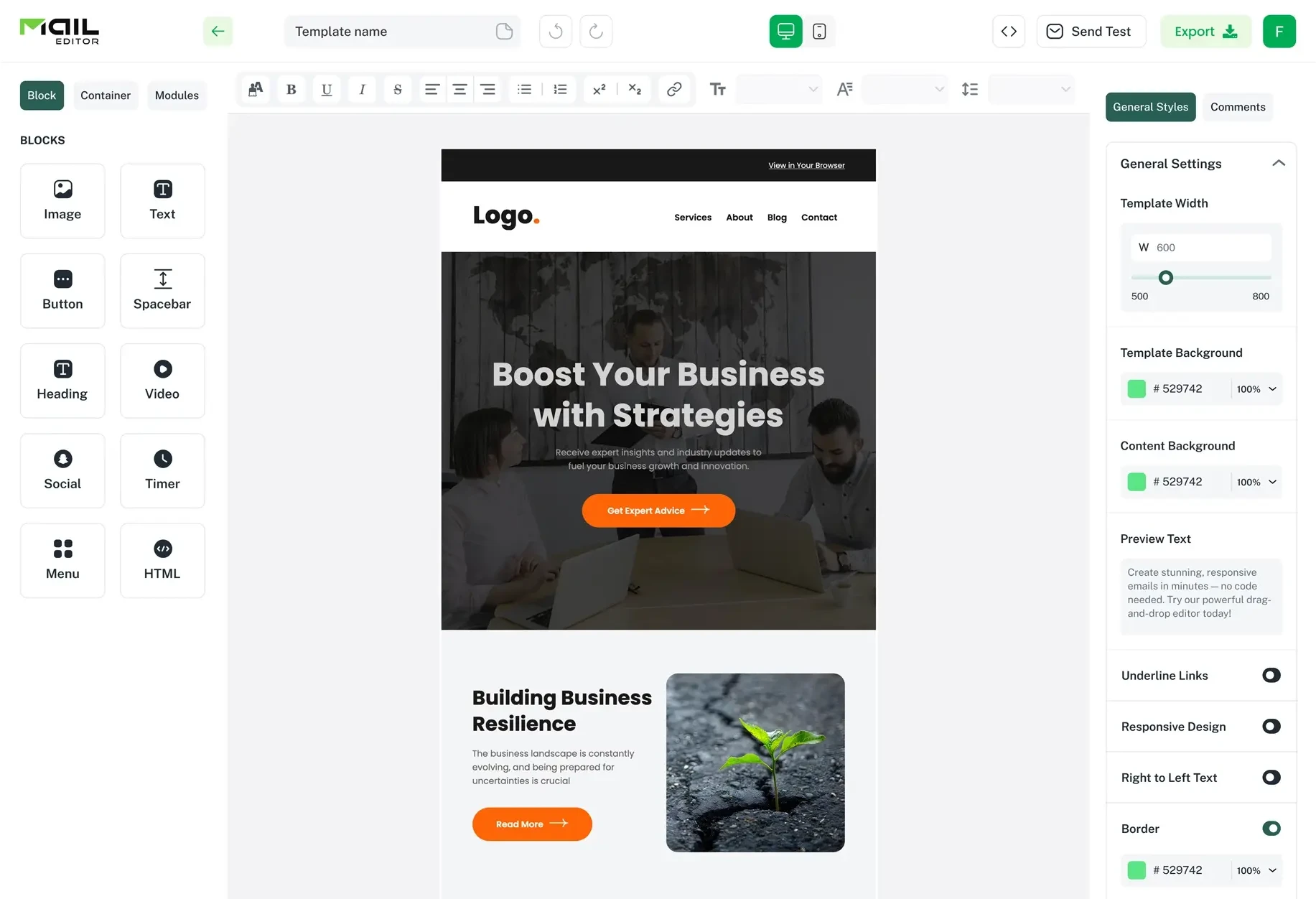
Tools like MailEditor shine here. It lets users edit email visually with its drag and drop features, without having to code. This simplifies email design even for those who don’t have technical skills and expertise.
You can create or reuse responsive templates that ensure your emails look strong on mobile devices, which is where many clients read them.
Keep these design principles in mind when designing your emails.
- Use a strong header image from a recent project
- Keep calls to action clear and specific
- Write concise and scannable content
- Avoid cluttered layouts
As John Ruskin once said,
Quality is never an accident; it is always the result of intelligent effort.
That applies to your emails just as much as your construction projects.
Step 4. Write Compelling Subject Lines and Preview Text
The subject line is one of the most important elements in your email. It is often the first thing that the recipient sees, and determines whether your email gets opened or ignored. This means email subject lines deserve more time than most teams give it.
I recommend writing multiple versions before finalizing one that gives the best clarity and value. You can also test small variations to see what resonates with client groups, and what doesn’t.
Step 5. Automate Sequences and Schedule Campaigns
In 2026, manual sending feels severely outdated. It takes a long time and slows momentum. Automation works better. It ensures you send emails to client groups even during busy phases in a project, which helps to build and maintain consistency without any extra work.
Email automation examples can include the following.
- Onboarding sequences after a client signs a contract
- Follow-up messages after sending a proposal to a client
- Seasonal reminders before peak construction periods
Remember, the goal is to maintain steady communication that feels timely and professional. It helps to build trust with clients
Step 6. Track Performances and Optimize As Needed
Finally, keep an eye on your email’s defining metrics, such as open rates, click rates, and conversions. Without measurement, you’re just guessing how your email performs. But if you track the key indicators, it gives you a clear idea on whether your emails are working.
When projects are high value, even small increases in engagement can translate into meaningful revenue. That is why you should review email results monthly, identify what’s working, adjust what’s not, and optimize the process as needed.
This process of creating an effective email system is not flashy. It is structured and consistent, and when you stick to it with discipline, it turns your emails into a reliable growth channel for business and revenue.
Real-World Examples of Successful Construction Emails
Now, let’s make this tangible. Below are three real-world style examples you can adapt immediately. Each one is simple, direct, and built for response.
1. Project Completion Update
Subject Line
“Your renovation is complete and ready for walkthrough”
Body Text
“Hi Sarah,
We’ve wrapped up the final inspection and everything is ready for you to review. I’d love to schedule a walkthrough this week and answer any questions in person.”
CTA
“Confirm a time for your final walkthrough.”
Why This Works
It is specific and personal. It focuses on the next action rather than celebration alone. MailEditor makes it easy to reuse this layout with updated project photos and client names.
2. Proposal Follow Up
Subject Line
“Checking in on your commercial build proposal”
Body Text
“Hi Mark,
I wanted to follow up on the proposal we sent last week for your warehouse expansion. Let me know if you would like to review any line items together.”
CTA
“Schedule a quick review call!”
Why This Works
It is respectful of time and keeps momentum moving. You can automate this sequence, so that every proposal receives consistent follow up.
3. Seasonal Maintenance Reminder
Subject Line
“Is your property ready for winter weather?”
Body Text
“Hey there Jennifer,
As colder months approach, small structural checks can prevent costly repairs. We are booking winter maintenance visits now and would be happy to inspect your property.”
CTA
“Reserve your maintenance slot today!”
Why This Works
It connects timing with practical value. You can schedule this campaign to go out automatically before peak seasonal demand hits.
These examples are not complicated. They are clear, timely, and action focused. With the right structure in place, you can build a library of emails like this and deploy them in minutes rather than hours.
Advanced Tips to Boost Your Construction Email Campaigns
Once your foundation is solid, small refinements can dramatically improve results. If you want your construction company to stand out in crowded inboxes, I suggest making these upgrades.
Design for Mobile First
Most decision makers skim emails between meetings or on site. Short paragraphs, clear buttons, and vertical layouts make reading effortless on a phone.
Add Interactive Value
Consider linking to cost calculators, downloadable maintenance guides, or short PDFs explaining your process. Useful tools position your company as a resource, not just a contractor.
Reuse Strong Content Strategically
A client testimonial can be reshaped into a case study, then highlighted again in a seasonal campaign. Good content should work more than once.
Segment by Project Type or Client Interest
Commercial builds, residential renovations, and maintenance contracts require different messaging. Even basic segmentation increases relevance and response rates.
One Small but Practical MailEditor Tip
MailEditor lets you save high performing layouts as reusable templates, which saves your team the time and trouble of rebuilding emails from scratch each time.
Key Takeaways on Email Marketing for Construction Companies
- Email offers strong return on investment and long term relationship building potential
- Staying visible with past clients increases repeat work and referrals
- Generic messaging and poor segmentation weaken results
- Mobile friendly design directly impacts open and click behavior
- Automation saves time while maintaining steady communication
- Tracking open rate, click rate, and conversions reveals what actually works
- A structured six step plan keeps your efforts organized and measurable
Conclusion
Construction companies thrive on precision, timelines, and follow through. Your communication strategy should reflect the same discipline. Email gives you a steady way to stay connected without adding chaos to your day.
When done thoughtfully, it strengthens relationships, supports repeat business, and keeps new opportunities warm until they are ready to move. It is not about flooding inboxes. It is about showing up consistently with value.
Start small. Choose one audience segment, one email type, and one clear objective. Build from there instead of trying to overhaul everything at once.
MailEditor templates can help you get your first campaigns out quickly without overthinking the design. Once momentum builds, refining and expanding becomes much easier.
The key is to begin.
Frequently Asked Questions About Email Marketing for Construction Companies
How Often Should I Send Emails to Clients?
Consistency matters more than frequency. For most construction companies, one to two emails per month keeps you visible without overwhelming clients. If you are running active projects, brief weekly updates can also make sense.
Can I Use Email Marketing for Both B2B and B2C Construction Clients?
Yes, but the messaging should differ. Developers and property managers expect data and timelines, while homeowners respond better to clarity and reassurance. Strong segmentation makes email marketing for construction companies effective across both audiences.
What KPIs Should I Track First?
Start with open rate, click through rate, and lead conversions. These three metrics reveal whether people are paying attention to your message and taking action. Once those are stable, you can refine subject lines and content for better results.
Written by
A full-stack digital marketer and passionate blogger with more than seven years of hands-on experience helping brands grow, rank, and thrive online.
All postsPopular Blogs
Email Design2 mins to read
Top Email Template Builders & HTML Email Editors for 2026
Compare the best email template builders and HTML editors to design professional, responsive campaigns without coding.
Email Design9 mins to read
Email Signature Size and Image Best Practices
The ideal email signature is 320–600px wide and 90–200px high. Learn the best image sizes, formats, file limits, and mobile-friendly design tips.

Email Tips7 mins to read
Best Drag and Drop Email Editors in 2026
Discover the best drag and drop email editors in 2026. Compare top tools, features, templates, pricing, and automation to build stunning emails fast.
Marketing7 mins to read
4 Best Unlayer Alternatives to Design Emails
Looking for Unlayer alternatives? Explore the 4 best email design tools to create beautiful, responsive emails faster and easier.
Marketing6 mins to read
5 Beefree Alternatives to Upgrade Email Design Workflows
Looking for a better email design tool? Explore 5 Beefree alternatives that streamline workflows, improve collaboration, and elevate email campaigns.